




Editors’ Note:
The reborn faiV newsletter is on an every-two-week schedule. Tim Ogden wrote it for years, and it’s been Tim’s baby. But we’re here to provide another set of voices. Don’t worry, Tim will be back in 2 weeks.
About us: Laura is FAI’s Deputy Director and, as she writes below, spent years writing and analyzing foreign aid policy. She now lives with her family in northern Italy. Jonathan teaches at NYU and used to write about finance as it connects to poverty. These days, he’s mainly writing about poverty as it connects to finance.
- Laura Freschi and Jonathan Morduch
1. Ahem
Laura: Is it poor form to begin with an objection to the editor? My beef is with Tim, who buried our most recent paper as the 10th link in his last edition. (As the comms manager for many previous editions of the faiV, I can assure you that no one clicks on the 10th link.) In this paper we map out the ways that the “triple whammy”—insufficient funds, illiquidity, and instability—affects the decisions of small firm owners. It’s one thing to know that revenues and expenses are volatile; it’s another to see how these forces shape hiring decisions, employment relationships, credit choices, and aspirations.
2. A tribute
Laura: Last November, about 100 people came together at NYU to celebrate the career of a singular figure, Bill Easterly. Angus Deaton, Lant Pritchett, Michael Clemens, Nancy Birdsall, and others paid tribute to Bill’s uncommon character and broad influence.
Forced out of the World Bank for dissent after 16 years, Bill went on to CGD and NYU, writing papers and books that remain required reading for students learning to think critically about international aid. His latest book is Violent Saviors, which was launched in November.
Others will cite his impressive stats on Google Scholar, but I — so lucky to have been hired by Bill straight out of grad school to work on his brainchild of a blog we called Aid Watch — can tell you about his impact in person. Though sometimes snarky and always exacting on the page, Bill in the flesh was (and still is): exceedingly humble, kind, and very funny.
Rarely are people (let alone academics) both brilliant thinkers and agile communicators, but Bill is both. The year was 2009, and it was a freewheeling time in the international development and econ blogosphere, when crusty academics, swashbuckling NGO workers and overworked PhD students all took up blogging on Wordpress and Movable Type. Snark was our currency and satire our lingua franca (RIP the blog Two Blokes in Niamey). Still, we subscribed to each others’ RSS feeds and wrote earnestly in each others’ comments sections. We even met in person sometimes, at ICT4D meetups and fail faire happy hours (now relics of a prepandemic time). We poured time into these pursuits as if they mattered, as if enough “sunlight” could make the system better. As if enough transparency could make aid deliver on its promises to help the poorest, and achieve, for once, the latest iteration of Development Goals. Not imagining that so much that was good and life-saving could be gutted along with the bad and the bloated, in an inhumane and illegal couple of days in 2025.
That “Let a Hundred Flowers Bloom” blogosphere era is over (perhaps an overly-apt analogy), but Bill stands as a model, no matter the medium, of someone who speaks truth to power and stands by his principles. His core insights haven’t aged: that development happens from within, not from above; that the poor deserve rights, not rescue. On my best days, I’m hopeful that these ideas will guide whatever we build next.
3. Before you give away your kidney, read this
Jonathan: Economics is driven by mathy thinking. For economists, a lot of policy analysis, and even personal choice, comes down to costs vs benefits. With that frame, the logic of radical generosity is straightforward if you do the math. Utilitarian math makes it a no-brainer to give away most of your money to people in need, for example, or even to give away a spare organ. But that doesn’t make it easy or obviously right in a larger sense. I was thinking about the math after watching Penny Lane’s new-ish documentary on Netflix, Confessions of a Good Samaritan (trailer). It’s all about the not easy part of donating a kidney to a stranger. Lane is funny, self-aware, and variously certain and uncertain, but the math of altruism drives her forward. In the end, donating her kidney was not a no-brainer, and what I took away was how the math gets in the way of understanding her act of giving: Sometimes we do things precisely because they’re hard, not because the math says it should be an easy choice. (For more on the complexity of being a Good Samaritan, check out the conversation between the NYT’s Ezra Klein and James Talarico, a candidate for the US Senate in Texas.)
4. But does it work?
Jonathan: For a big chunk of my career, I wrote a lot about microfinance. As a result, I get a lot of questions about whether microfinance “works” or not. It’s a harder question to answer than it seems, especially if you don’t limit yourself to adjudicating Muhammad Yunus’s vision of transformational change through household entrepreneurship. This makes the results of a newly-revised working paper on microfinance impacts in China so striking. Shu Cai, Albert Park, and Sangui Wang find big positive impacts that contrast with most previous RCTs. The authors know that they’re pushing against a literature that has become skeptical about previously-boasted impacts. Unlike other programs, this one involves funds made available in designated “poor villages.” The funds deliver relatively large loans, do not insist on repayment in the form of steady installments, and charge low interest rates (unlike typical microfinance programs). Being in a village with a fund leads to an increase in average household income by 32% relative to the control mean, driven by sharp increases in self-employment income (up by 59%) and wage employment income (up by 41%)—the latter mostly due to migration. So, does microfinance work? I’d say “it depends,” but that sounds wishy-washy. A clearer response is that impacts depend critically on how microfinance programs are designed and implemented, who is targeted, and which outcomes are of most interest. In the particular context in China, it seems, they got most of that right.
5. Digital finance: After you look at the numbers, watch this
Jonathan: The 2025 version of the World Bank’s Findex Report is the latest distillation of financial activity around the world. 79% of adults globally now own a financial account, and mobile banking is quickly gaining ground. The new Digital Connectivity Tracker shows that smart phones are becoming ubiquitous: 90 percent of the people using the internet in their developing economy sample got online using a smartphone. It’s a remarkably fast diffusion of technology, thanks in part to affordable Chinese brands (Xiaomi, Huawei, and the Goliath-beater Transsion).
This transition isn’t all easy or necessarily positive (cue again Tim’s pointer from the last faiV about who really pays for “free” electronic payments). If you want to know what the expansion of fintech means in people’s lives, good and bad, the nine 7-8 minute videos created by the Digital Finance for All project tell important stories. I expected slick promotional videos on the wonders of digital finance, but what they’ve delivered is a frank and sometimes troubling account of how the new technologies create costs while at the same time opening possibilities. One video describes hidden dependencies. Another confronts conflicts between social approaches to money and the new highly- individualized technologies. This isn’t about stopping technology adoption. Instead, the videos point to places—“pain points” in UX-speak, though that doesn’t capture the depth of the concerns—where regulators and digital providers need to step up.
Image of the Day
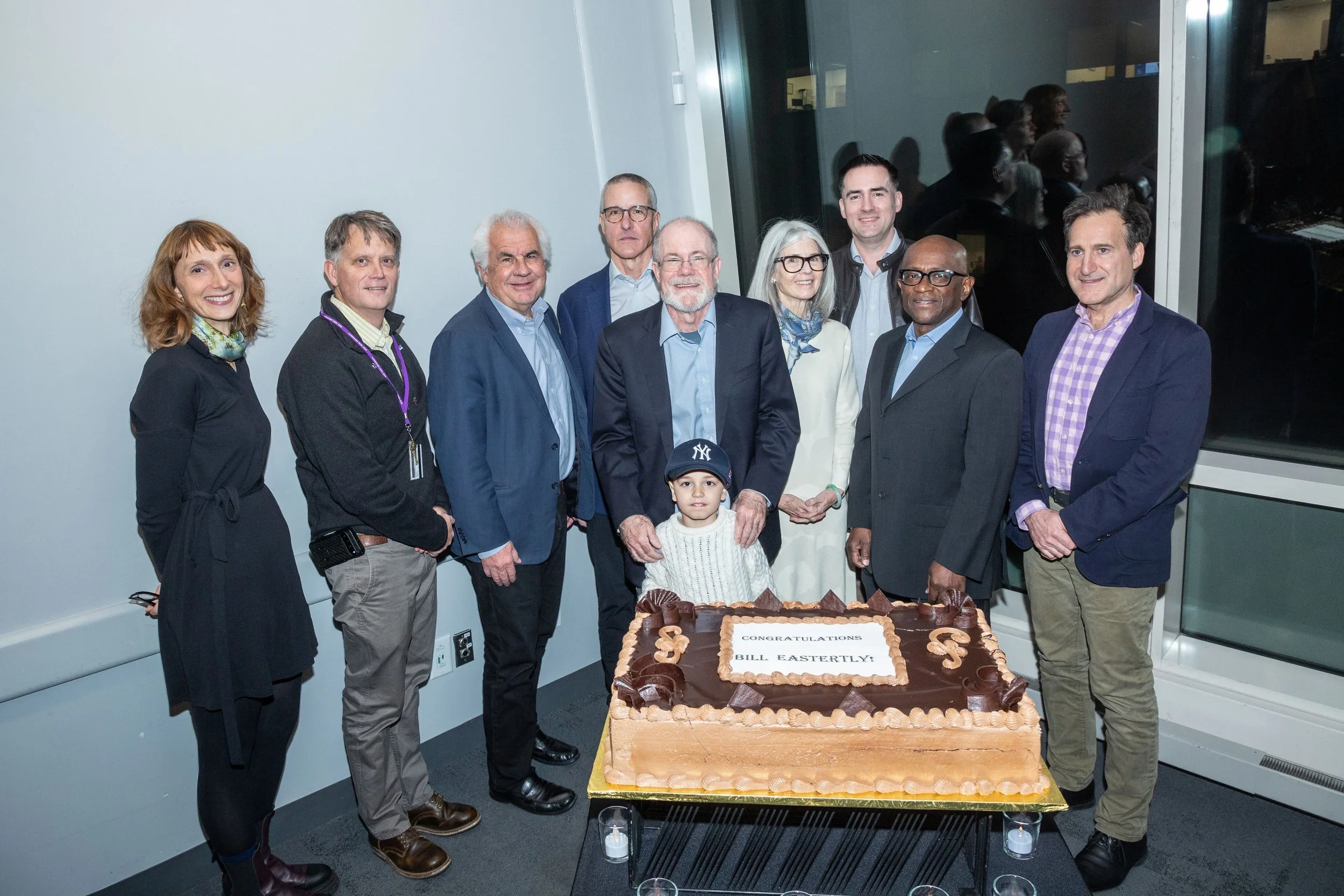
Some of the roughly 100 people who gathered to celebrate Bill Easterly at NYU, November 2025. Left to right: Laura Freschi, Tim Ogden, Lant Pritchett, Ross Levine, Bill Easterly (and grandchild), Liz Dalton, Michael Clemens, Yaw Nyarko, and Jonathan Morduch. Goldman: Courtesy of NYU Photo Bureau.
The faiV is written by Timothy Ogden, Jonathan Morduch, and Laura Freschi, and produced by the Financial Access Initiative at NYU's Wagner Graduate School of Public Service
Email: fai-wagner@nyu.edu
To read this in your inbox, subscribe to the faiV.