




Editors’ Note:
This was an unusually difficult faiV to organize and write for two reasons—it feels like everything is some combination of AI and politics, and the new things just kept coming so fast, shifting how I was thinking about and grouping items, which is an item in itself. It’s going to get messy from here.
If you’re nostalgic for a simpler world, and you happen to be near Atlanta, Baltimore, Chicago, New York or St. Louis, you should join us for one of our Small Firm Diaries-USA mid-point events in the next few weeks.
- Tim
1. No More Equilibria
My difficulties assembling the faiV are emblematic of what I think is the key unknown about the way the world is changing: is the pace of change in various dimensions accelerating in ways that prevent reaching new equilibria? That doesn’t require that “real” change is happening faster. It could just be that the metanarrative is changing too fast to distinguish real from perceived change and incorporate (accurate) new information.
One of the key things that has always attracted me about economics is the emphasis on movement toward new equilibria. Here’s Alex Imas celebrating equilibria via a paper about how people adapt to changing AI models. At the same time, there is a real problem in the mismatch between the systems we have created to do and publish “rigorous research” and the change happening. And the fear (again, more on that throughout) is that too many of the systems, and too many of us, cannot change fast enough to reach new (at least semi-)stable equilibria. A consistent underlying message from recent research on poverty is how much volatility, instability and uncertainty drive sub-optimal decisions. Are we all in that world now? Is this what it felt like (admittedly to some very small slice of humanity) in the Industrial Revolution? Am I doing exactly what Alex is saying not to do—underestimating how people dynamically adjust? Or is it just that at the dawn of Internet disruption I was young, and now I wear my trousers rolled?
2. AI
Creating that sense that equilibria are now forever out of reach, it seems like every few hours there’s a new post, story, podcast, video, tweet or something that is trying to wrestle with this new reality. I “put down” writing the faiV for 48 hours and there were several new pieces to include. I was going to start discussing a post from Scott Alexander about Moltbook, but the whole discussion seems hopelessly out of date in just two weeks.
Flowing most directly from the end of equilibria is this piece from the Atlantic about the potential for labor markets changing way too quickly for adjustment. That was written by one of the left-of-center writers who are roundly criticized in this piece for failing to update their beliefs about what AI really is. And here's a different version of that critique of the critiques from Kelsey Piper.
After reading the pieces below, I’m pretty sympathetic to those latter two points of view, at least more sympathetic than I am to the now infamous stochastic parrot. Here’s a long New Yorker piece about how Anthropic doesn’t really know what Claude “is”. Here’s Ross Douthat of the New York Times in conversation with Anthropic co-founder Dario Amodei. Here’s Tyler Cowen in conversation about AI with Megan McCardle in a podcast called Reasonably Optimistic which seems a feat in itself.
And just this morning there's a VoxDev podcast with Anton Korinek on “Thinking like an economist about AI, labour markets, and AGI.” Should I consider that evidence for or against new equilibria emerging?
3. AI and Finance
If your head is spinning as much as mine, and you want to get back to thinking about financial inclusion and poverty and such things that are the typical domain of the faiV, this item is for you. Never mind, this is kind of head spinning stuff too.
A few weeks ago I got to spend a couple of hours talking with Patrick McKenzie—faithful faiV readers will recall me raving about his posts for Bits About Money and podcasts at Complex Systems—and one of the questions I asked him was about how he saw AI affecting the equilibria in consumer financial services, specifically when it came to fraud and scams. If that isn’t something you think about often, here’s a piece from Bloomberg on how industrial-scale fraud factories (often in Southeast Asia, but also in North Korea and Russia) are using AI to get “better” at it. I like to think that conversation nudged him to his most recent post, which is specifically about how financial services firms and the government handle (or don’t handle) financial fraud. Everyone who reads the faiV should read this post.
In more general “AI and Finance” news, Arpit Gupta is teaching a course on AI and Finance and is, in effect, live-blogging his lectures and materials. The first post is his Three Rules for AI in Finance. FinRegLab had an AI Adoption in US Financial Services symposium back in November, and recently posted the summary report and the videos of the sessions.
4. AI and Economics
At least we can find solace in one thing that never changes: arguments over what economics is and what economists believe, and what various public figures understand or don’t about economics. You likely have seen at least mention of the conversation between Jon Stewart and Richard Thaler, which didn’t reflect well on Stewart’s engagement with the field (and perhaps worse, his response was a follow-up with a well-known critic of economics, who is not himself an economist, about what economics is). Here’s Jerusalem Demsas with a dissection (to put it mildly).
But there are real questions about what economics is, or at least the profession of economics, in the age of AI. Here’s a thread from Paul Novosad about using AI to write a paper in a few hours, and here’s David Yanagizawa-Drott doing the same. To be clear these are both done as experiments to think about the implications of the technology being able to do this. Is this a Deep Blue Moment for economists as well as coders? What does it mean to be an applied economist when the multiverse is kind of here?
While you’re pondering that, note that Chris Blattman is building a ClaudeBot (ClaudeBlattman) as a tool for managing field research.
5. The Means Testing Industrial Complex
At this point you probably need a break from AI right? This is a break from AI, right? Right? The Means Testing Industrial Complex, and, well, the Means Testing Industrial Complex. I apologize in advance to everyone still fighting to limit the effects of DOGE cuts to global health—these will really depress you.
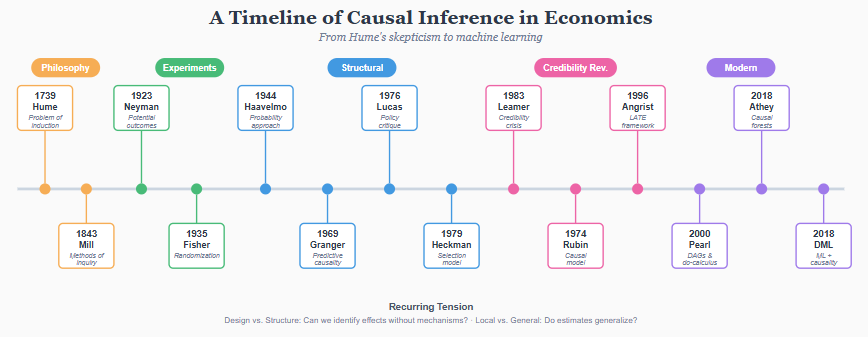
Graphic of the Day
The faiV is written by Timothy Ogden, Jonathan Morduch, and Laura Freschi, and produced by the Financial Access Initiative at NYU's Wagner Graduate School of Public Service.
Email: fai-wagner@nyu.edu
To read this in your inbox, subscribe to the faiV.
Ten years ago, FAI managing director Tim Ogden published Experimental Conversations, a collection of interviews with economists and other people who critique, promote, and use randomized controlled trials (RCTs) in development economics. One of the interviewees was Michael Kremer, a pioneer of the movement, now a Nobel laureate, and recently appointed Chief Economist of the World Bank.