



In this video we created for Financial Inclusion Week, we sift through data to tell the story of businesses straddling the borderlands between the cash and digital economies after COVID-19.
Read MoreFAI in the News: Financial Education Programs Won't Address Widening Literacy Gaps in the US
FAI’s webinar on the Financial and Literacy Gap was cited in an article published by Yahoo Money on September 11, 2022. The article by Kerry Hannon explored the reasons for a steady decline in financial and digital literacy in the United States over the last 12 years, and spoke to experts about measures to counter the decline.
Read MoreMicrofinance Meets Pandemic: Two Years Later, Two Years From Now
Two years ago we hosted a faiVLive on “the gathering storm” of the pandemic and the crisis it presented for low-income households and the MFI industry. It’s clear now the industry has endured the storm better than many (or at least Tim) expected.
Read MoreThe Revolution MUST be Digitalized
If MFIs fail to digitalize, it could mean the end of financial services for the rural poor, because the business case is so challenging, particularly compared to the diverse, low-cost opportunities to serve the higher-value, connected urban market. In short, this could end years of progress towards financial and social inclusion.
Read MoreRegister for our June 7 Webinar: Microfinance Meets Pandemic: Two Years Later, Two Years From Now
The Financial and Digital Literacy Gap: It’s a Trap!
There’s no question that there are big gaps in financial literacy between the rich and poor, and between those included and excluded at every income level and in every country. As digital finance becomes more important, the gap grows and takes on added dimensions. No wonder that financial (and now digital) literacy programs attract attention and millions of dollars globally.
Read MoreThe Financial and Digital Literacy Gap: It’s a Trap!
Welcome to this month’s faiVLive webinar. Watch the recording on our YouTube channel here.
There’s no question that there are big gaps in financial literacy between the rich and poor, and between those included and excluded at every income level and in every country. As digital finance becomes more important, the gap grows and takes on added dimensions. No wonder that financial (and now digital) literacy programs attract attention and millions of dollars globally.
Read MoreResources on Digital Money and Upcoming Webinars
Part 2 on The Role of Digital Money in Financial Inclusion
Back for a second run, Tim Ogden and Jesse McWaters of Mastercard continued their conversation on digital money, and grappled with questions focused on applications of digital currency to advance financial inclusion, cybersecurity, and the interplay between regulation, consumer protection and innovation.
Read MoreDigital Money Systems Explained: In Conversation with Mastercard’s Jesse McWaters (Part B)
This is the second post of a two-part blog that distills the conversation from our last webinar, on digital money, with FAI’s Tim Ogden and financial policy expert Jesse McWaters, Head of Global Digital Public Policy at Mastercard. The first part covered some basic frameworks for thinking about these concepts. This one covers the regulatory environment around digital systems.
This two-part blog post distills the conversation from that webinar. The first part covered some basic frameworks for thinking about these concepts. This one covers the regulatory environment around digital systems.
Read MoreDigital Money Systems Explained: In Conversation with Mastercard’s Jesse McWaters (Part A)
In our December faiVLive webinar, FAI’s Tim Ogden sat down with financial policy expert Jesse McWaters, Head of Global Digital Public Policy at Mastercard, to demystify some basic questions around digital money and its evolving role in financial inclusion. What’s the difference between a digital payment system and a digital currency? What is blockchain really and how should we use it? Who makes the rules in a decentralized digital money system? Do those rules protect or expose consumers? Can the offerings and their regulations be designed to be pro-poor?
This two-part blog post distills the conversation from that webinar. This one covers some basic frameworks for thinking about these concepts. The next will cover the regulatory environment around digital systems.
Read MorePart 1 on The Role of Digital Money in Financial Inclusion
In this edition of the faiVLive, the Financial Access Initiative’s Tim Ogden and Jesse McWaters, the Global Head of Regulatory Advocacy at Mastercard, explored basic frameworks for understanding the differences between the rapidly growing types of digital currencies. They covered new and evolving digital means of exchange, how they interact, and what that means for pro-poor financial inclusion.
Read MoreRegister Now | From M-Pesa to Dogecoin to the Digital Naira: The Role of Digital Money in Financial Inclusion

Join FAI’s Tim Ogden in conversation with Jesse McWaters, the Global Head of Regulatory Advocacy at Mastercard, to explore some basic frameworks for understanding the differences between the rapidly growing types of digital currencies. Through this session you’ll gain a better grasp of new and evolving digital means of exchange, how they interact, and what that means for pro-poor financial inclusion.
Read MoreBuilding an Inclusive Financial System
In 2009, FAI founder Jonathan Morduch was part of a group that determined “half the world is unbanked.” Ten years later, the latest Global Findex tells us that the world’s unbanked population has been nearly cut in half. A combination of focused public and private efforts, aided by technology advances, yielded massive, though uneven, progress. It’s worth celebrating the gains, but also reflecting on what is still left to do. What lessons have we learned from the last 20 years that can close the rest of the inclusion gap? Why has inclusion in wealthier countries stalled? What does the inclusion agenda leave undone? How can technology be part of building more bridges to excluded communities?
This edition of the faiVLive was based on a new report from the Aspen Institute’s Financial Security Program, Building An Inclusive Financial System, that tackles those questions and more.
Read MoreWelcome to Today's faiVLive: Building an Inclusive Financial System

In 2009, FAI founder Jonathan Morduch was part of a group that determined “half the world is unbanked.” Ten years later, the latest Global Findex tells us that the world’s unbanked population has been nearly cut in half …
Read MoreRegister Now | faiVLive: Building an Inclusive Financial System
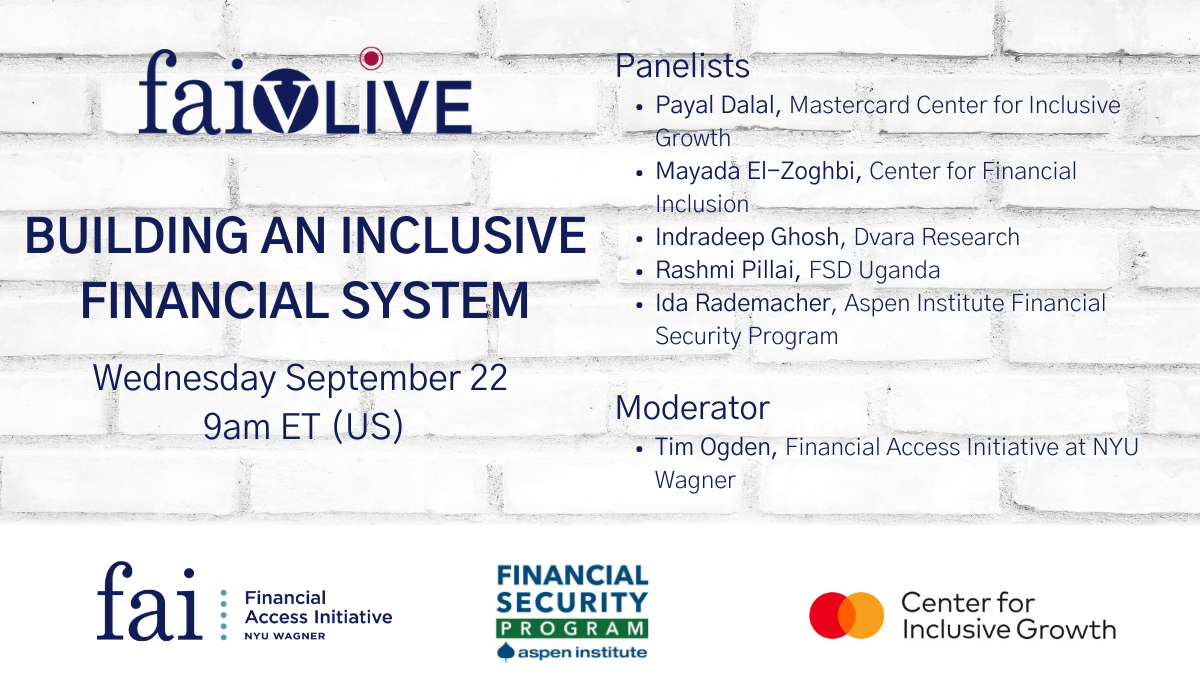
In 2009, FAI founder Jonathan Morduch was part of a group that determined “half the world is unbanked.” Twenty years later, the latest Global Findex tells us that the world’s unbanked population has been nearly cut in half …
Read MoreWhen is Fintech Pro-Poor? 4 Key Takeaways on Risk, Transparency & Sector Priorities
The Elusive Quest for Diversity: Measuring Who, What and Where in the faiV
What gets measured gets managed? Not always. We tracked the diversity of the sources featured in our faiV newsletter, and here’s what we found. While we still haven’t made up our minds on what the right targets are or how to get there, we are convinced that more people keeping track of and reporting data on these dimensions is an important part of figuring out how to get it right.
Read MoreWhen is FinTech Pro-Poor?
In this edition of the faiVLive, with a group of expert panelists from around the world, we delve into the possibilities for FinTech to serve the poor and reduce inequality. Six years after McKinsey heralded “a new era of digital globalization,” what have we learned about when, and where, FinTech meaningfully advances inclusion, and when it creates a new (digital) divide? When does FinTech (in the words of Greg Chen of CGAP, during this edition of the faiVLive) build a bridge and when does it dig a moat?
Read MoreWhen is FinTech Pro-Poor? Today's faiVLive Reading List and Resources
Welcome to today’s faiVLive Webinar. With a group of expert panelists from around the world, we delve into the possibilities for FinTech to serve the poor and reduce inequality. Six years after McKinsey heralded “a new era of digital globalization,” what have we learned about when, and where, FinTech meaningfully advances inclusion, and when it creates a new (digital) divide? When does FinTech (in the words of Greg Chen of CGAP, during this edition of the faiVLive) build a bridge and when does it dig a moat?
We also explore how expectations seem to differ from place to place: while FinTech in developing countries is generally presumed to be pro-poor, in wealthier countries there is more skepticism that digital innovations will advance inclusion for the poorest in society. Why is that? What are appropriate expectations of FinTech innovation? Should we be more skeptical of FinTech in countries with large inclusion gaps? Should we be less skeptical of new business models and tech-enabled services in wealthy countries?
Read More