



Small businesses in the US employ nearly two-thirds of workers earning low wages, making them central to both economic mobility and the quality of work itself. Shared Success, launched by Aspen Institute's Economic Opportunities Program with support from the Gates Foundation, is built on the premise that job quality is fundamental to economic resilience, particularly in historically underserved communities. The project worked with 11 community development financial institutions (CDFIs) to embed job quality support into their programming.
The Financial Access Initiative led the evaluation of the demonstration, working with EA Consultants to conduct fieldwork in the first half of 2024. Surveys with 177 business owners and qualitative interviews with 77 of those owners generated insights into how to encourage businesses to improve job quality, how those investments affect the business, and how CDFIs can scale improvements among their clients.
This blog sets out some of the key findings of the midterm evaluation. Read the full midterm report here.
Even financially constrained businesses found ways to improve job quality
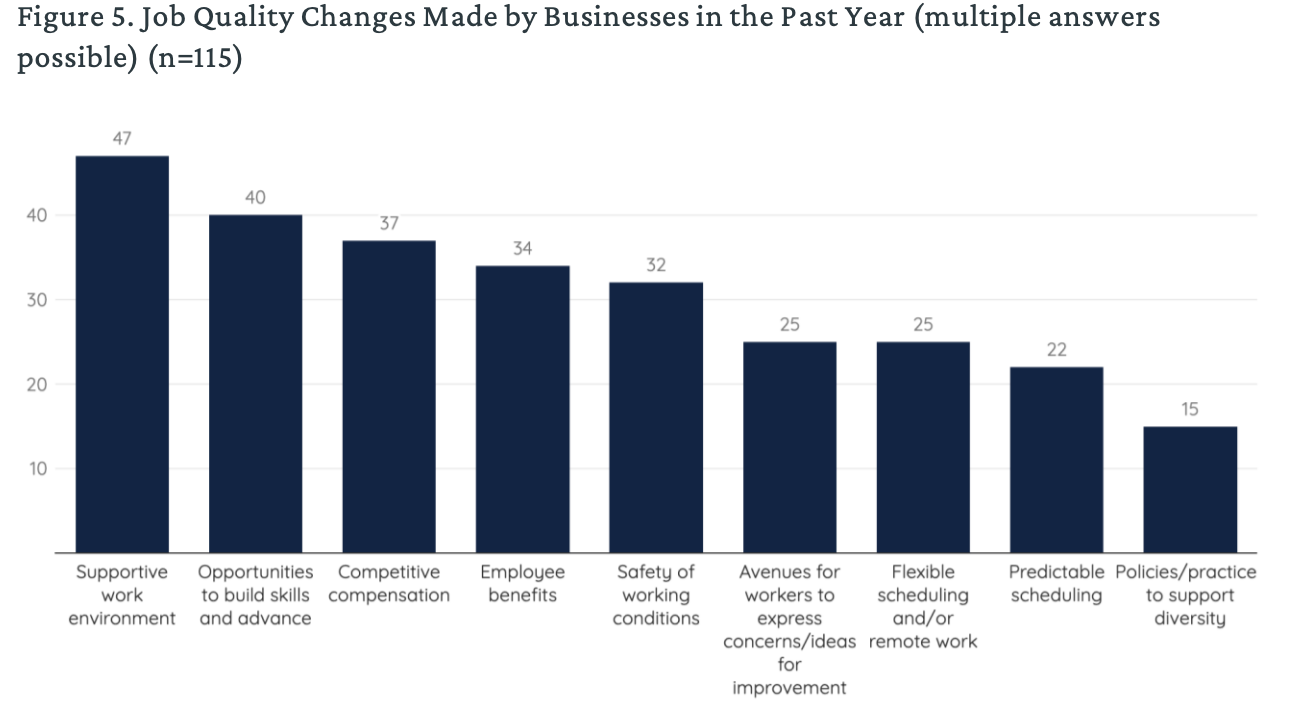
Three-fourths of business owners in our sample made at least one job quality improvement in the year prior to the survey, predominantly by creating more supportive working environments (47%), offering skill-building opportunities (40%), and improving compensation (37%) and employee benefits (34%). They made these changes despite the same share (74%) of businesses reporting that financial constraints were their biggest barrier to making job quality improvements. These findings show that while higher wages and expanded benefits are often considered the primary levers for improving job quality, businesses in the demonstration found meaningful ways to invest in their workers even when budgets were tight.
CDFIs are a primary source of job quality knowledge for owners
Most owners (62%) said they learned about job quality through their CDFI—evidence that embedding job quality support into CDFI advisory work reaches owners. Across the demonstration, 87% of survey respondents felt more informed about job quality at midterm than before it started, with prior experience remaining an important source for many (57%). Owners reported gains in specific areas: fostering supportive work environments (56%), employee benefits (53%), and creating safe working conditions (47%).
Productivity and regulatory compliance motivate job quality improvements
When asked to rank the business factors that most influenced their decisions to improve job quality, respondents placed increasing workplace productivity at the top, followed by meeting regulatory requirements. This reflects the changing policy environment many of these businesses operate in: across the states where the CDFIs are located, minimum wages have risen, paid leave requirements have been introduced, and retirement plan mandates have taken effect, creating pressure to act. The rankings suggest that many owners need a concrete business or regulatory reason to act.
Barriers to further improvements
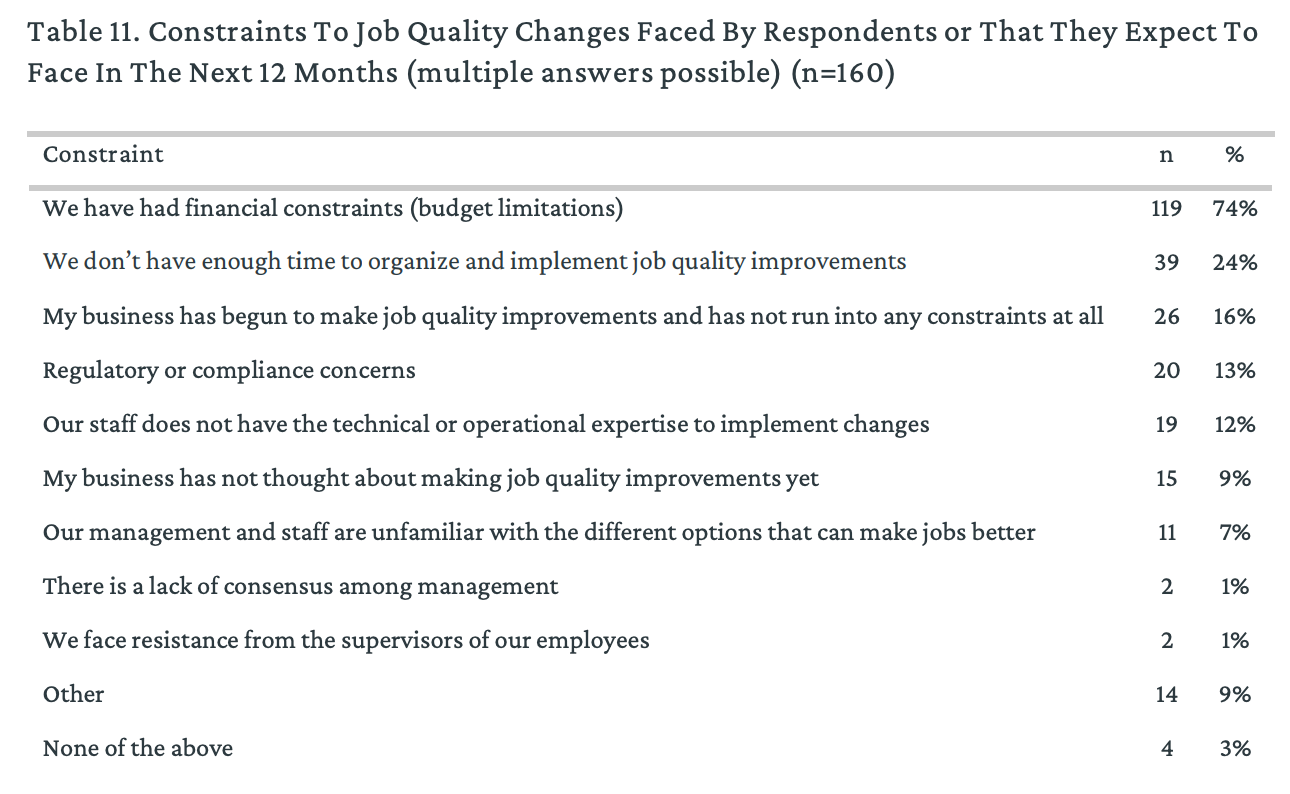
As mentioned above, financial constraints were the most common barrier to implementing job quality improvements (74%), and this was reported across business sizes and sectors. Some owners noted, though, that business growth had gradually expanded their ability to invest in workers over time. One childcare business owner illustrated this arc, describing how early-stage constraints gave way to more substantial investments in wages and training as the business became more financially stable.
Beyond financial constraints, 24% of owners said they didn’t have the time to implement changes, while 13% expressed regulatory or compliance concerns. Others mentioned lack of expertise, resistance to change, or disagreement about which changes to pursue.
The Shared Success midterm evaluation offers early evidence that, when supported by mission-aligned CDFIs, small businesses can and do invest in better jobs, even in the face of real constraints. Read the full midterm report here, and watch for the final evaluation, which includes both business owner and worker perspectives.

Ten years ago, FAI managing director Tim Ogden published Experimental Conversations, a collection of interviews with economists and other people who critique, promote, and use randomized controlled trials (RCTs) in development economics. One of the interviewees was Michael Kremer, a pioneer of the movement, now a Nobel laureate, and recently appointed Chief Economist of the World Bank.