



1. faiVYourJMP: Let's start there with a paper from Ryan Edwards on palm oil plantation expansion in Indonesia. That he finds trade-offs certainly shouldn't be surprising, much less astounding, but it is surprising how well he documents how the growth of export-led agriculture reduces poverty and increases consumption--including the specific channels by which that happens--and the connection to deforestation. Specifically, "each percentage point of poverty reduction corresponds to a 1.5-3 percentage point loss of forest area." Put another way, it's astounding to be able to see the price of poverty reduction outside of a carefully designed cash-based experiment.
And let me give a shout out to the Development Impact Blog team at the World Bank who were the inspiration to do this. Their crop of "Blog your JMP" posts is growing by the day and includes many entries worthy of your attention.
2. MicroDigitalFinance: Here's an astounding story about predatory lending and debt collection in New York (and from there, across the US). And I don't care how cynical you are, this is stunning because it's perfectly legal--so legal that there are registered investment companies gathering capital in public markets to do more of it.
That story then led me, via Rebecca Spang, to a book that came out at the beginning of this year that I'm embarrassed that I didn't know about, City of Debtors: A Century of Fringe Finance by Anne Fleming. It tells the story of small dollar credit in New York City and the attempts to regulate it and protect consumers, with lots of unintended consequences along the way. Although I've only begun to read it, what's astounding is how easily, if you changed the names of places and people, you could convince someone this was a book about modern microfinance. There's one chapter that could easily be pasted into Portfolios of the Poor with no one the wiser. Fleming is a law professor, and so she doesn't make the connection to the economics literature, past or present (at least that I've seen so far), which is frustrating but also assuages my guilt at being unaware of the book. Anyway, if you care about financial services for low-income households, regulation and/or consumer protection, you need to pick up this book.
It would be easy to make a snide and cliche comment about those who cannot learn from history, but is too much to ask to learn from present in other places? Here's a story about "neo-banks" in the US attempting to remake the banking industry, while confronting the hard reality that even without a physical presence, the margins on transactional accounts are razor thin. But, like Fleming's book, it's easy to read this as a story about how banks and MFIs are struggling to cope with the threat of digital financial services being provided by telecom firms which are built on a high-volume, low-margin business model.
That is a major theme of the e-MFPs new report on trends in microfinance/financial inclusion, released this week. It's the output of a survey of providers, funders, consultants and researchers on where the industry is headed. I was encouraged to read that other major challenges noted include "client protection, privacy...and preventing an erosion of the social focus of financial inclusion...in the face of new entrants." I'm betting those aren't on the list of very many people in the fintech/neobank space in the US.
Finally here's a story from September that somehow slipped by me: Kiva is working with the government of Sierra Leone to use blockchain to create a national ID/credit bureau. I'm still trying to wrap my head around this one but it definitely seems like the kind of thing that would benefit from and generate lots of opportunities to learn from other places. If any of the faiV readers at Kiva want to share more, please call me.
3. MicroSmallMediumFirms: I'm often frustrated that I don't get to spend more time thinking about firms--those of you who know me know I've been wanting to start a project on "subsistence retail" for years. Hope springs eternal--maybe next year is the year I get to do that.
But in the meantime, here's a job market paper from Gabriel Tourek featured on Development Impact that finds an astounding reaction to a tax cut in Rwanda: the firms pay more even though they owe less. What's going on?
Week of November 12, 2018
1. Our Algorithmic Overlords: Since it hasn't featured for a few weeks, I'm going to lead with our old friends this week. If you're in development circles, you know about Aadhaar. And if you're a reader of the faiV you know about China's intrusive citizen monitoring and control (let's dispense with calling it a "social credit score"--this apologia for what's happening is frightening in its own right). But did you know that Venezuela is on the forefront of assigning every citizen an ID and tracking their behavior, including their votes (maybe)? Here's a Twitter thread with some additional details from the reporter of that piece. Guess who's providing the technology?
The frightening frontier in the US is from private technology companies, well, let's be honest, the frightening frontier is Facebook. Here's a New York Times investigation of the company's conduct that is jaw-dropping, over and over again. Where is Teddy Roosevelt when you need him? For now, we've got Kara Swisher's thoughts on cleaning up the "toxic smoke".
Tying the domestic and global back together, here's Susan Liautaud of CGD on how the perspective on the ethics of automation and AI may look different in developing countries.
2. Development Finance and Banking: Sticking with CGD, here's the polymath of development, Charles Kenny, on reforming the World Bank's Private Sector Window to comply with, y'know, the World Bank's guidance on appropriate design for private sector subsidies.
The big question for development finance (and social finance of all sorts) is whether it is crowding-in or crowding-out private sector investment, or neither. Here's Paddy Carter on the "Elusive Quest for Additionality" (have to love a shout-out to old school Bill Easterly) in summary form and in full length paper form (with van de Sijpe and Calel).
Let's say that there is additionality and DFIs are increasing capital flows to developing countries. The next big question is, what impact does that have? Here's Judith Tyson and Thorsten Beck on how those capital flows are affecting domestic financial system development. They conclude that the capital flows are too pro-cyclical and not doing enough to boost domestic capital markets.
There is a specific kind of capital flow that is actively undermining financial development specifically and development in general: regulations on anti-money-laundering and anti-terrorist-financing (regulations are a form of capital right?). Here's a brief from the Humanitarian Policy Group at ODI on how bad it's gotten in humanitarian relief. And just a reminder that this is a pervasive problem. No really,it's a pervasive problem.
Speaking of financial system development, here's an interesting post on what is happening in Ghana's banking sector--well, what's happening is consolidation, the post explains why and what's next. And here's a perspective on the liquidity crunch for Indian NBFCs.
3. MicroDigitalFinance: It feels like we might be hitting an inflection point on mobile money services, the point where it's no longer possible to talk about it without prominently noting the negatives. CGAP has a new report on digital credit in Kenya and Tanzania, which leads them to the conclusion that "It's Time to Slow Digital Credit's Growth in East Africa." Late payment and default rates are enough to make any MFI executive faint. One particularly interesting tidbit: loans taken in the morning are much more likely to be repaid than loans taken at night. That's not really surprising but it's amazing to have that level of insight. Of particular concern is that many borrowers don't understand the terms of the loans they are taking. All the progress made on consumer protection for MFIs doesn't matter much if the market shifts to getting credit elsewhere.
Week of November 5, 2018
1. Household Finance: One of the trips keeping me busy was to Mexico City for the PRONAFIM conference. Here's a video version of my current thinking on household finance, in Spanish.
Of course, one of the key questions in household finance is to what extent a household is a household. I've had a hard time not thinking about this recent paper from Afzal et al, which through a series of "lab in the field" experiments, shows there are a lot of schisms in the household. Let me just quote from the abstract: "Subjects are often no better at guessing their spouse's preferences than those of a stranger, and many subjects disregard what they believe or know about others' preferences when assigning them a consumption bundle." Is there some explanation there for the puzzle in the Graphic of the Week (see below?).
In the household finance realm I often pick on financial literacy--specifically as a bellweather for evidenced-based policy (if money is going into financial literacy, evidence isn't making a dent on policy). Here's some interesting new evidence on financial literacy and why it doesn't seem to work, from Carpena and Zia. They are looking for what parts of financial education might affect behavior, and find attitudes matter more than awareness or numeracy. I feel like that connects to this new paper from Gine and Goldberg documenting endowment effects in account choice in Malawi, and that the endowment effect can be overcome with experience, but maybe not.
2. Inequality: Teaching a class on wealth inequality and policy makes anything on the topic grab my attention just a bit more. And there is a lot out there. On the downside, there's a lot out there and my attention is drawn to all of it. Here's a handy Twitter thread guide (and in a perhaps easier to follow/read format) to the global inequality literature that I found very helpful. Here's a new paper from Ayyagari, Demirguc-Kunt and Maksimovic calling into question the idea that a group of "star" firms are pulling away from others and boosting inequality. You probably already know about this, but the Chetty team has published their Opportunity Atlas. And here's a recent paper from Card et al. on the role of school quality in transmitting economic inequality in the US during the 20th century (in digest form here).
3. Our Algorithmic Overlords: Nothing particular profound here but I couldn't resist pairing these two pieces together: a) "China’s brightest children are being recruited to develop AI ‘killer bots’" and b) A list of artificial intelligence programs that do "what their creators specify, not what they mean." I suppose since the actions of the AI programs sound a lot like children trying to annoy their parents, China's approach seems optimal?
Week of October 15, 2018
1. China: This is a very meta way of kicking things off, but I do think often of the gaps in knowledge that go along with the language gap between centers of academic inquiry and China (and to a lesser extent, India, Indonesia and Nigeria). It takes a lot of cognitive work to push back against the unconscious equation of value/quality with English-language facility, and that's just for the papers and stories that ever do appear in English (thank goodness for Jing Cai!). Anyway, here's a small attempt to address some of the knowledge gap.
The P2P lending industry in China continues to melt down in very scary ways, and in ways reminiscent of bank runs in the US around railroad bubbles in the late 19th century. The common ingredients--a working class population with enough income to start seriously saving and limited outlets for saving/investing and even more limited consumer protections. It's ugly and getting uglier as the authorities crack down on both the lenders and protestors who have lost their savings.
But that's not the only credit market problem in China. The head of a very large state-backed lender was pushed out of the party for corruption (and he's not the first and likely not the last). Meanwhile, local governments have been creating weird vehicles to borrow via private (or are they public? it's hard to know what's the right phrase to use when it comes to China's hybrid economy) markets. Current estimates suggest there is a $5.8 trillion dollar local government credit problem. Amidst the trade war, the Chinese economy seems to slowing just at the time these credit market problems are coming to light--I don't see anything in these stories about a causal effect--and there are other signs of bad news. If you are a Planet Money listener, you may recall a recent story about a rumored "vast postal conspiracy" that largely checked out. This week the Trump administration announced that it is withdrawing from the Universal Postal Union, a system that was set-up for the US' benefit post-WWII but became a huge boon to small Chinese manufacturers. Planet Money's "The Indicator" also did a series recently on China's social credit scoring system, including talking with someone who has been blacklisted.
Finally, here's a story to lead us into the next item: accusations of racism by Chinese firms are becoming increasingly common in Kenya and other African countries were China has been investing heavily.
2. Global Development: The gap (particularly the growth gap) between high-income and low-income countries is what the field is all about, indeed "it's hard to think about anything else." The gap has been stubbornly high and growing since World War II. Dev Patel, Justin Sandefur and Arvind Subramanian have a new post at CGD, reacting to a new paper about the lack of convergence, pointing out that cross-country convergence has been happening since 1990. The authors of the paper respond on Twitter.
There's a curious connection that back when many of the original ideas of development economics posited that convergence should happen--e.g. poorer countries should grow faster than richer ones--while recognizing that it wasn't happening, one of the prescriptions was a "big push" to help poor countries escape a poverty trap. The idea of the big push eventually went into hibernation, but was revived around the time that the convergence did start happening (though we didn't know it yet). This time the big push was at the village level, not the country level. It didn't work any better there. Last week, the results of "the first independent impact evaluation" of Millenium Villages Project (of a village in Ghana) were released and the bottom-line is scathing. There was no gap-closing here--the only positive effects found, the study notes, could have been accomplished at dramatically lower cost. On a similar note, here's a look at another MVP-project village, Sauri, Kenya, and finding that locals did not believe in the benefits of MVP enough to bid up the prices for land in the village. Which honestly is kind of remarkable given all the money that was showering into the villages. You would think people would want to move there simply to benefit from the opportunities for corruption/patronage.
Finally, here's a really fascinating example of a growing gap--the gap in gender preferences grows with economic development and gender equality. This definitely feels like an "everything is obvious once you know the answer" example.
Week of September 24, 2018
1. Poverty and Inequality Measurement: How do you measure poverty, and by extension, inequality? Given how common a benchmark poverty is, it's easy to sometimes lose sight of how hard defining and measuring it is.
Martin Ravallion has a new paper on measuring global inequality that takes into account that both absolute and relative poverty (within a country) matter--for many reasons it's better to be poor in a high-income country than a low-income one, which is often missed in global inequality measures. Here's Martin's summary blog post. When you take that into account, global inequality is significantly higher than in other measures, but still falling since 1990.
The UK has a new poverty measure, created by the Social Metrics Commission (a privately funded initiative, since apparently the UK did away with its official poverty measure?) that tries to adjust for various factors including wealth, disability and housing adequacy among other things. Perhaps most interestingly it tries to measure both current poverty and persistent poverty recognizing that most of the factors that influence poverty measures are volatile. Under their measure they find that about 23% of the population lives in poverty, with half of those, 12.1%, in persistent poverty.
You can think about persistence of poverty in several ways: over the course of a year, over several years, or over many years--otherwise known as mobility. There's been a lot of attention in the US to declining rates of mobility and the ways that the upper classes limit mobility of those below them. That can obscure the fact that there is downward mobility (48% of white upper middle class kids end up moving down the household income ladder, using this tool based on Chetty et al data). I'm not quite sure what to make of this new paper, after all I'm not a frequent reader of Poetics which is apparently a sociology journal, but it raises an interesting point: the culture of the upper middle class that supposedly passes on privilege may be leading to downward mobility as well.
There's also status associated with class and income. On that dimension, mobility in the US has declined by about a quarter from the 1940s cohort to the 1980s cohort. That's a factor of "the changing distribution of occupational opportunities...not intergenerational persistence" however. But intergenerational persistence may be on the rise because while the wealth of households in the top 10% of the distribution has recovered since the great recession, the wealth of the bottom 90% is still lower, and for the bottom 30% has continued to fall during the recovery.
2. Debt: What factors could be contributing to the wealth stagnation and even losses of the bottom 90% in the US? Just going off the top of my head, predatory debt could be a factor. If only we had a better handle on household debt and particularly the most shadowy parts of the high-cost lending world. Or maybe it's the skyrocketing amount of student debt, combined with bait-and-switch loan forgiveness programs that are denying 99% of the applicants. I'll bet the CFPB student loan czar will be all over this scandal. Oh wait, that's right, he resigned after being literally banned from doing his job.
Week of September 17, 2018
1. MicroDigitalFinance: A few weeks ago I wrote that small-dollar short-term loans have always been the bane of the banking industry. We're getting a new test of that. US Bank is launching an alternative to payday loans: loans are between $100 and $1000 and repaid over three months. Interest rates are well below payday lending rates, but still around 70% APR--interestingly on US Bank's page about the loan they very clearly say: "Simple Loan is a a high-cost loan and other options may be available." All of that is good news. But the loans are only available to people with a credit rating (even if it's bad), who have had bank accounts with US Bank for 6 months and direct deposit for 3 months. It will be fascinating to watch take-up, repayment rates, and outcomes--those are where banks have always struggled in this market. Here's Pew's Nick Bourke's take on the US Bank move and the potential for others, with some more regulatory action, to follow suit.
I occasionally remark on insurance being the most amazing invention of all time. It's astounding that it works at all, even in the most developed, trusting and well-regulated markets (see this attempt by one of the US's oldest life insurance providers to collapse the market); it's not surprising that it's a struggle to make it work elsewhere, in the places where households face more risk and would most benefit from access to insurance. So I'm always interested in new work on insurance innovation. Here's a new paper on a lab-in-the-field insurance experiment in Burkina Faso. The basic insight is that many potential purchasers struggle with the certain cost of an insurance premium versus the uncertain payoff. It turns out that framing the premium around an uncertain rebate if there is no payout--which makes both premium and benefit uncertain--increases take-up, especially among those that value certainty most. Yes, you probably need to read that sentence again (and then click on the link to see that even that obtuse sentence is marginally clearer than the abstract). If we want to delve into the details of insurance contract construction, there's also a new paper that delves into how liquidity constraints--a huge factor that hasn't generally gotten enough attention--affect the perceived value of insurance contracts, and how to adjust the contracts accordingly.
And finally, William Faulkner's dictum that "The past is never dead. It's not even past." applies to fintech. A new paper finds that common law countries in sub-Saharan Africa have greater penetration of Internet, telecom and electricity infrastructure, and thus much greater adoption of mobile money and FinTech. That's consistent with history of banking literature that finds common law countries do better on financial system development, financial inclusion and SME lending.
For the record, I've clarified in my own mind the difference between the MicroDigitalFinance and Household Finance categories. The former provides perspective on providers, the latter on consumers. I reserve the right to break that typology as necessary or when it suits me.
2. Household Finance: I suppose another way to distinguish between the two categories is that MicroDigitalFinance features bad news only most of the time, while Household Finance is just all bad news. At least that's the way it feels when I come across depressing studies like this: Extending the term of auto loans (e.g. from 60 months to 72 months as has become increasingly common during this low-quality credit boom) leads to consumers taking loans at a) higher interest rates, and b) paying more for the vehicle. Liquidity constraints mean consumers pay much more attention to the monthly payment and get screwed.
Week of September 10, 2018
1. US Inequality: I talk a lot about congruence between the US and developing countries, but usually in the context of sharing lessons in the financial inclusion domain. But there are other domains where there is a lot more commonality. For instance radically corrupt policing. While this paper has been circulating for awhile, it's worth revisiting over and over again, and it's acceptance for publication is a convenient excuse. US cities and towns, when faced with budget deficits, ramp up arrests and fines of and property seizures from black and brown citizens but not white ones. Here's the easy to share Twitter thread version so you can send it to your not so economics-paper-inclined friends. To be clear, it's only second-order racism. The reason seems to be it's much easier to get away with stealing from people of color because of systemic racism.
Systemic racism like the premium that blacks pay for apartments, a premium that rises with the fraction white a neighborhood is. Lucky that the place you live has little effect on the quality of your education or your future job market opportunities. Oh, wait.
The US is still deeply segregated (cool visualization klaxon) and there has been virtually no progress on that front in decades. Part of the reason is exclusionary zoning which puts a floor on home prices well above the reach of black and brown households. Apparently though, the Department of Housing and Urban Development is planning on tying future grants to cities to cutting zoning restrictions on multi-family dwellings. That would be a rare bright light in the current administration's deregulation push.
2. Cash: I haven't done anything on cash transfers, universal, conditional or otherwise in quite a while. This week we got a flood. I'm going to try to cover the landscape first, before some summary thoughts. Blattman, Fiala and Martinez have an update on their cash grants to youth clubs in Uganda paper--the one that found large gains after four years. After nine years, the controls have caught up. Chris used the analogy of "a tightly coiled spring" as an explanation for why the gains in the first four years were so surprisingly large--and that analogy may still hold. No matter how high the spring jumps, it eventually returns to baseline. Here's Chris's Twitter thread on how his thinking has changed. Here's a Vox article by Dylan Matthews. At this point, if you pay any attention at all, you should expect Berk Ozler to have some thoughts. He does.
Meanwhile, IPA pulled off the greatest unintentional (I'm told by reliable sources--hi Jeff!) mass market advertisement for the release of a development economics working paper in history when the NYTimes Fixes column ran a long-delayed piece by Marc Gunther on using cash as a benchmark for development programs on Tuesday. The paper was being released Thursday. That paper, a comparison of a Catholic Relief Services program to a cost-equivalent cash grant, and a much larger cash grant, by McIntosh and Zeitlin is here. The IPA brief is here. The Vox article is here. And Berk's thoughts (about the Vox coverage really) are here. And Tavneet Suri's. But I'll give Craig and Andrew the last word--here's their post on Development Impact on how they think about the study and the issues.
Week of September 3, 2018
1. Social Investing: Calling out the bland and meaningless rhetoric in social and impact investing almost seems unsporting--it's just too easy but it's Friday after a long week so I'm going to do it anway. Take this piece from John Elkington, who coined the term "triple bottom line," (Please), saying it's time to "rethink" or "recall" or "give up on" it (all his phrases). Why? Because the term has been misunderstood and misappropriated for uses well short of what he intended. Instead he thinks we need "a triple helix for value creation, a genetic code for tomorrow’s capitalism." But apparently not a clear definition or a recognition of trade-offs under scarcity.
Then there's this piece from the Wall Street Journal on the meaninglessness of words like "ethical", "impact" and "sustainable" in the mutual fund world. It's a treasure for the sheer density of laugh out loud snippets. For instance, Deutsche Bank switched out the word "dynamic" in the title of a family of funds and replaced it with "sustainable." Vanguard's bar for a company being "socially responsible" is literally not enslaving people or manufacturing weapons banned by international treaty. But my favorite is probably this quote about buyers of "ESG" funds: "We do hear from investors that have bought funds that they never realized did something." (Protip for non-WSJ subscribers who may not otherwise take the trouble to read this gem, search the title in an incognito window, click on the result link and close the invitation to subscribe and you'll be able to read it.)
2. Household Finance, Part I, Theory: Not realizing that funds did something is a good transition to Matt Levine's musings about the relationship between financial services providers and customers (scroll down to "How much should an FX trade cost?"). Matt is writing specifically about investment and corporate banking but the theory fully applies. In short, 'smart' large customers treat banks like commodity providers and ruthlessly push margins toward zero. Banks have to go along because these are large customers and economies of scale matter in financial services. So the banks make up those margins by charging 'loyal' customers much more than 'smart' customers. Which is, shall we say, not what 'loyal' customers think the banks should be doing and they rightly get very angry when they find out. So loyal customers should be more like smart customers and treat banks like commodity providers. The application of faiV interest is the Catch-22 for lower-income households: they only very rarely have the time and choice to treat financial services like a commodity, so they are almost inevitably left subsidizing wealthier customers. And even banks with good intentions struggle to do otherwise, because if you don't have the large customers, you can't drive costs down through scale.
In other theory news, one of the common motivating theories on helping low-income households is helping them plan. Planning is hard when facing scarcity. There's been encouraging evidence of the value of specific planning for getting people to follow through on their intentions. Here's a new paper testing the value of planning for one of the only two intention-action gaps that can rival the intention-action gap on savings: exercise (the other being dieting). It finds that careful detailed planning of an exercise routine has a precisely zero effect on follow-through.
Finally, here's a piece that at face value seems to be talking about the empirical transition away from cash (in the US). But look closely and it's really musing on the theory about the costs of cashlessness for lower-income households, something that deserves a lot more attention, on theory and empirics, than we seem to be getting right now. And it features Lisa Servon and Bill Maurer so you should definitely click.
3. Household Finance, Part II, Practicum: I don't remember how I stumbled across this paper about how US households respond to high upfront medical costs. It's not new, but it was new to me, though I suppose you can also say it's very old to anyone who has paid attention to healthcare consumption in low-income countries. The authors find a large decrease in spending, but no evidence that households are price shopping or making any differentiation between high-value and low-value services. Something to think about--how much of what we call "shocks" for low-income households are actually "spikes" that they didn't have the tools and bandwidth to manage (liquidity) for?
Week of August 27, 2018
Editor's Note: I'm still playing catch-up this week, and perhaps you are too. It's the "end of summer" in the Northern Hemisphere after all, that week we all get to, in a panic, confront all those things we had put off to the Fall AND all those things we thought we would get done during the "less busy" summer. Catching up notwithstanding, this is a somewhat truncated edition of the faiV, as I head into a weekend of labor related to the above.--Tim Ogden
1. Small Dollar Financial Services: I've been doing a lot of reading the last few weeks about the history of consumer banking (Hi Julia!), and by history I mean going back to the Middle Ages and before. From that reading, it's clear that small dollar lending has always been the bane of the banking system--and there is nothing new under the sun (thanks, David Roodman!). Which certainly colors my view when I see stories about overhauling the overdraft system in the US. Not that I don't think there is room for significant improvement. Overdraft is perhaps the worst possible way to manage small dollar lending--by pretending it's something else while still charging exorbitant fees that would make many microfinance institutions blush. There are plenty of ideas, like this story on a non-profit payday alternative lender which charges roughly half the fees of its competitors. The intent of the story seems to be offering this as a real alternative, but the details keep getting in the way. The nonprofit really is nonprofit in the literal sense of the word, not even being able to pay its CEO a $60,000 per year salary regularly, and facing "four near-death experiences" in 9 years--that sounds about par for the course in small dollar lending from the historical record.
2. Algorithmic Overlords: Yuval Noah Hariri has a new piece in the Atlantic, the title of which is just candy-coated confirmation bias for me, so how could I resist putting it in the faiV: "Why Technology Favors Tyranny". I'm feeling validated that I started reading Asimov's I, Robot to my kids this week. But back to Hariri, two thoughts: a) borrowing a category from Tyler Cowen, this is a very interesting sentence: "At least in chess, creativity is already considered to be the trademark of computers rather than humans!", and b) the picture Hariri paints bears a remarkable resemblance to the Allende plan in Chile specifically, and to almost every example in Seeing Like A State, it's just that the technology is finally catching up to the political ideology. The big question, of course, is whether the technology will yield any better results.
One more item I couldn't resist is this piece about blockchain and supposed complacency toward technological innovation in development. The most important thing to know is that the two examples given of the benefits of a decentralized ledger (e.g. blockchain) are two of the most centralized and highly policed ledgers in existence: SWIFT and Visa payment networks. It continues with a few potshots at small dollar fintech lenders and then some ersatz blockchain evangelism about power to the people. Let's hope the author reads many of the pieces linked above, but especially Hariri's. And just because, here's a story about the very first blockchain hiding in an ad in the New York Times in 1995.
3. Methods and Evidence: You've likely seen the uproar over ridiculous nutrition studies (on alcohol and dairy--clearly the message is to only drink dairy-based cocktails this weekend) this week. I saw someone on Twitter commenting on how the credibility revolution seems to have passed right by nutritional epidemiology, probably because it would mean that no studies ever got published.
Part of the credibility revolution is the emphasis on open data and replication. Here's a report on the latest large scale replication effort (of 21 social science studies published in Nature and Science). Thirteen of the 21 were generally replicated, but the effect size was roughly half of that originally reported. Of course, this raises the question of what "successful replication" means again. Here's a Twitter thread from Stuart Buck of the Laura and John Arnold Foundation on the difficult distinction between failed replication being a part of the scientific learning process and a failed replication as part of identifying shady research and publishing practices.
Here's a troubling story about unreliable administrative data. The US Department of Education asked school districts to start reporting "school-related shooting" incidents. There were 240 reported. But follow-up reporting was only able to verify 11 of those incidents and 161 were explicitly denied. Don't let the emotional subject of school shootings distract entirely from the reminder that there are always problems with data gathered like this, no matter what the subject. And pause for a moment to remember that it is data like this that Hariri fears will be used to automate administrative regimes.
The point of these studies, whether ridiculous nutritional ones, or administrative-data based ones, is most often to influence behavior and policy. Here's Jean Dreze on the challenge of evidence-based policy, and the need for economists "to be cautious and modest when it comes to giving policy advice, let alone getting actively involved in 'policy design.'"
4. Global Poverty: On the topic of evidence-informed policy choices, one of the most hotly debated questions in the field right now is what is happening with global poverty. At face value it seems like this is just a question of going to look at the data. But as with so many other areas, different people see very different things in the data (even if it is accurate). It all depends on how you measure poverty and whether you care more about absolute or relative numbers. There was a glimmer of detente in this debate this week as Jason Hickel and Charles Kenny published "12 Things We Can Agree On About Global Poverty." But that only lasted a day before Martin Ravallion chimed in with this Twitter thread, which begins, "it seems they only agree on the obvious, and ignore some less obvious things that really matter."
If you're looking for another way into these debates and the various issues that arrive, here's a Washington Post story about Nigeria displacing India as home to the largest number of people in absolute poverty. Maybe.
5. Social Investment and Philanthropy: I highlighted a couple reviews of Anand Giridharadas' new book Winners Take All last week. Here's another, from Ben Soskis, which I include because it's the best one yet. The theme of Giridharadas' book (and Rob Reich's new book as well) is being skeptical of the power of large-scale philanthropy or social investment. Here's a thread from Chris Cardona, of the Ford Foundation, on the multitudes contained in the word philanthropy, which is certainly important to take into account when considering the critiques. But the question of who is a philanthropist, who is abusing their power, and the trade-offs of institutionalization of philanthropy are always messy. Here's a story about a viral GoFundMe campaign to help a homeless man in Philly who gave his last $20 to rescue a stranded motorist. If you have Calvinist sympathies like me, you'll probably guess what happened next. Finally, here's Ed Dolan of the Niskanen Center on whether we need the charitable deduction.
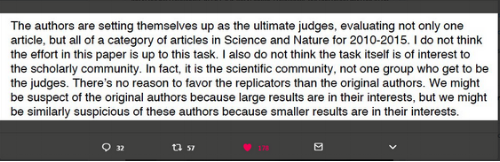

Returning to the topic of methods and evidence-based policy, two images popped up in my Twitter thread this week that I couldn't get out of my head. One is a snippet from a peer reviewer of the social science replication paper highlight above, explaining why it was not published in Nature or Science even though it was replications of papers from those journals. And second is a picture taken from a talk John List was giving this week about his career. You have to ask, does science advance via replication or via funerals? Via Brian Nosek and Ben Grodeck respectively.
Week of August 20, 2018
1. Financial Inclusion and Digital Finance: The last time I was writing the faiV, various takes on the Global Findex data were being featured prominently. So it only seems fitting to come back to that as I return. Greta Bull of CGAP has a two-part blog, part I and part II, reacting to Beth Rhyne's and Sonja Kelly's take (may I take a moment to smile at the inclusion that sentence reveals?) on the Hype vs. Reality of inclusion. Bull argues that the Findex data shows greater progress on inclusion than Rhyne and Kelly see. For what it's worth I lean to toward Bull in this debate. It would be surprising, given the incredibly rapid progress in access, if the access-use gap wasn't growing, especially in countries with relatively low levels or recent gains in access as network effects won't kick in for awhile.
There is another concern beyond the use/access gap--does use of the available accounts make people better off. Here's a new paper from Kast and Pomeranz showing that providing free savings accounts in Chile led to lower debt burdens (and some additional evidence on rotten kin). On the other hand here's an open letter from Anup Signh to Kenyan Central Bank governor Patrick Njoroge making the case for urgent regulatory action on digital credit to protect borrowers. On the third hand (hat tip to Brad DeLong) mobile money seems to have saved lives (note no counterfactuals there, but it seems plausible) during Ebola outbreaks in Liberia and Sierra Leone during Ebola outbreaks by ensuring that response workers got paid.
Of course, benefit depends not just on use, but on who is using the services. Microsave found that 80% of the "addressable LMI market" in India was not being served by fintechs, and, with CIIE's Bharat Inclusion Initiative, has launched a "Financial Inclusion Lab" to help Indian fintech's address that market.
2. Our Algorithmic Overlords: If you've gotten out of the habit of reading the faiV, what better way to grab your attention back than sexbots! Here's Marina Adshade, an economist at UBC, with a thoroughly economic argument about how sexbots could make marriage better (by changing how it works and what it does). And here's Gabriel Rossman, a sociologist at UCLA, making the counterargument. Apparently he reads Justin Fox.
On a much more prosaic, and more urgent, front, there have been a raft of stories on the increasingly alarming situation in Northwest China where the tech-driven panopticon seems to be racing ahead in the service of persecution of Muslims and ethnic minorities. Here is the NYTimes "inside China's Dystopian Dreams". Here's Reuters on the "surveillance state spread[ing] quietly." MIT Technology Review asks, "who needs democracy when you have data?" And here's Foreign Affairs on the "coming competition between digital authoritarianism and liberal democracy." If I have a bone to pick it's the lack of attention to the possibility of "authoritarian democracy" that comes along with a surveillance state and AI overlords.
3. Global Development: If sexbots don't get your attention, what about hyperselectivity of migrants? I think, quite a while ago, I linked to Hicks, et al. on the systematic differences between those who migrate from rural to urban Kenya, and those who stay on the farm, finding that urban productivity is a factor of the traits of the workers who migrate.
Week of August 6, 2018
1. Universal Basic Income (unpopular locale edition): In 2010, to replace massive energy and food subsidies, the Iranian government apparently implemented a cash transfer program that began covering over 95% of the population (75 million people) before targeting seems to have lowered coverage to less than 35 million. The story in two sentences: “In 2011, the first full year of the program, transfers amounted to 6.5% of the GDP and about 29% of the median household income. After three years of inflation, the amount transferred per person is down to less than 3% of GDP per capita.” New research finds minimal effects on labor supply or hours worked, though the short time horizon for the large transfers makes it hard to generalize. I suspect that the short time horizon is only part of the reason this policy hasn’t gotten more attention.
2. Our AI Overlords: Another AI benchmark falls. In a much-publicized practice event Sunday, an AI system developed by OpenAI beat a team of former pros at a mutliplayer video game called Dota (they had a livestream and posted a video that is totally inscrutable to me). This was expected given the rapidly-growing computation devoted to experiments like this, though it looks like the training required by this model (190 “petaflop/s-days,” whatever those are) was less than would be expected from extrapolating past large experiments. (The costs for those experiments are also growing by an order of magnitude every year and a half, which seems… unsustainable.) Apparently OpenAI are planning a Dota match against current pros later this month, so expect to hear more about this.
3. Cryptocurrency (or Weird Household Finance): Apparently “proxies for investor attention strongly forecast cryptocurrency returns,” which seems… a little obvious? And Matt Levine discovers a subculture of people who intentionally participate in pump and dump schemes in marginal cryptocurrencies as a form of gambling, which raises the question - what do the other people investing in marginal cryptocurrencies think they are doing?
The First Week of August, 2018
1. FinTech Charters: Just as the industry takes off for summer vacation, the US Treasury Department released its long-awaited fintech report and the OCC issued a call for fintech charter submissions. I’ve spent the past week sorting through scores of analyses and reactions. Here's American Banker on takeaways from the Treasury report and from the OCC's announcement. What does this mean for all things financial inclusion and innovation? Well, it certainly opens the door for many providers to expand their reach and their potential impact. It will likely be an expensive and involved path, but one that could ultimately give some fintechs much needed lift. However, this is still early in the game. I would expect to see lawsuits and challenges from incumbents now that the charter program is official.
2. Financial Stress and the Lunar Cycle: For many consumers, the end of the month represents constant instability as accounts are reduced to zero and bills become due. While income volatility is the umbrella issue, the specific actions that trigger this instability on a cyclical basis live both in our minds and in the products we use. One of our Entreprenuers-in-Residence, Corey Stone, tackles some big thinking on the topic in his series End of the Month. Drop in regularly to learn more about how human behavior can lead to suboptimal decision making, why long accepted product standards lead to this paucity of funds at the end of the month, and other insights into our monthly budgeting woes.
3. The Gig Economy: The difference between 4% and 40% is pretty significant. And the fact that the US Government doesn’t know how big the gig economy is, in short, a problem. To be fair, it’s not all the government’s fault. The variance in numbers can be attributed to a wide range of perceptions about what constitutes gig employment: full-time, part-time, etc. But no matter what the measurement, the impact is real. Gig employees enjoy the benefits of self-determination, but can often miss out on many of the benefits of traditional employment like insurance, savings vehicles, and more. The result can be regular cash flow gaps and challenging financial tradeoffs. To better design products and create guardrails, it’s imperative that we all find a better – more credible – way to measure this new workforce reality.
Week of July 23, 2018
1. Food Fights and Methods: First, over on the Economics That Really Matters blog, Paul Christian and Chris Barrett summarize their paper on US food aid and conflict. They call into question the results of an influential paper finding a causal link between US food aid and conflict. The authors follow up with a methodological note on the use of instrumental variables with panel data.
Next, the most recent issue of the American Journal of Agricultural Economics (AJAE) has a nice article, comment, and response. In the article Ore Koren finds that it is food abundance, rather than food scarcity, that causes conflict across Africa. Marshall Burke writes in a comment that the effect sizes are implausibly large and are at odds with previous research. Koren responds to these comments by offering three explanations for the "implausibly" large effect sizes.
2. Randomistas are our new Algorithmic Overlords: At the development economics section of the NBER Summer Institute, Esther Duflo delivered a lecture entitled, "Machinistas meet Randomistas: Some useful ML tools for RCT researchers". Slides from the lecture are available here, and Dina Pomeranz was live Tweeting the lecture. The paper it was based on is here. On the surface it may seem like machine learning and RCTs are interested in different parts of empirical research--the former focused on prediction and the latter focused on causal identification. Duflo highlights a couple areas where using machine learning when analyzing an RCT can be beneficial.
3. Informal Insurance: In a recent article on VoxDev, Kaivan Munshi and Mark Rosenzweig summarize some of the insights from their 2016 paper on the impact of rural informal insurance networks on rural-urban migration in India. The authors first point out that the rural-urban migration rate is relatively low in India compared to other similar countries. The explanation for this is the presence of well-functioning rural informal insurance markets. In order for these informal markets to function well, however, mechanisms must exist to prevent households from reneging on their obligations to their network. A key way this plays out is in restrictions on mobility. This raises a question: What would happen if formal insurance were introduced? Munshi and Rosenzweig run policy simulations and find formal insurance arrangements may increase rural-urban migration. Relatedly, in a new AJAE paper, Kazushi Takahashi, Chris Barrett, and Munenobu Ikegami study how the introduction of formal index insurance affects informal risk-sharing arrangements in rural Ethiopia. They find little evidence of a crowding out of informal insurance from formal insurance products.
Week of July 16, 2018
1. Women's Empowerment: Our friends at JPAL released their long-anticipated Practical Guide to Measuring Women’s and Girls’ Empowerment in Impact Evaluations. It comes with a set of questionnaires and examples of non-survey tools that can be more effective at capturing the useful and reliable data. This new study from the U.S. Census Bureau is timely, showing that when a woman earns more than her husband they both tend to exaggerate the husband’s earnings and diminish the wife’s on their Census responses. Gender norms still shape survey responses, no matter where you are. Seems like a good time to revisit IPA’s discussions on mixed methods approaches to women’s empowerment measurement with Nicola Jones and with Sarah Baird from last year. Finally, the US House passed the Women’s Entrepreneurship and Economic Empowerment Act of 2018 this week. The bill seeks to improve USAID’s work on women’s access to finance, and is notable first because of its attention to some (not all) non-financial gender-norms constraints that impact women’s prosperity, and also because it calls for improvements to outcome measurement methods.
2. Migration: The first ever Global Compact for Migration was approved by all 193 member states of the UN last week except for the United States (Hungary is now saying it won’t sign the final document), and one of its 23 high-level objectives is to “promote faster, safer and cheaper transfer of remittances and foster financial inclusion of migrants.” A lot of the language in here sounds like the same old story on remittances, and I am skeptical of the laser-sharp focus on reducing prices (it calls to eliminate remittance corridors with costs higher than 5% by 2030), promoting financial education, and investing in consumer product comparison tools that aren’t based on evidence. Dean Yang’s 2016 study on financial education for Filipino migrants failed to find any positive impact on financial product take-up or usage, for example.
3. Remittances: What about looking to the behavioral econ world to enhance the positive effects of remittances? Behavioral nudges that can leverage digital finance look promising – Harvard Business Review had a nice piece last month on Blumenstock, Callen, and Ghani’s test of mobile money defaults to save in Afghanistan. This experiment is exciting because it shows that, with the right tools, successful interventions from the developed world, like Thaler and Benartzi’s Save More Tomorrow, can achieve similar results in other contexts. Linking remittance transfers to digital finance in the receiving country can create additional opportunities to enhance impact beyond savings, for example using data for credit scoring. Here’s an op-ed from Rafe Mazer and FSD Africa on the opportunities and risks surrounding data sharing models in emerging markets.
Week of June 18, 2018
1. Migration: If you don't get the "edition" reference, I think I envy you. But I care, and in the absence of other specific ways to oppose cruelty and barbarism, I'll spend some time here sharing some useful information about migration. Such as the fact that the US has become a "low-migration" country. I think this is as significant a change to the nature of the country as the closing of the frontier, especially since so many people don't seem to realize how much migration, whether within the US or to the US from other countries, has dropped.
On to that other crucial fact about migration: it's very very good for the people migrating and doesn't harm the people who are already there. Here's the newly officially published in AER paper by Clemens, Lewis and Postel studying the effect of the end of the Bracero program which led to 1/2 a million Mexican workers leaving the country, without any detectable benefits for native workers (employers simply invested in labor-replacing technology it appears). Here's a new NBER paper on the forced migration of Poles after World War II finding that migrants invested more in human capital for three generations. That's consistent with other work that shows long-term positive, sustained effects for people who move, even those who don't have full choice. Here's a story about how migrants fleeing the US to Canada are finding employment and thriving.
If you're interested in the big picture on global migration, the 2018 OECD International Migration Outlook is out.
2. Banking: I talk a lot about the overlaps between US and global financial inclusion issues--from household finance to consumer protection to business models to regulation. So I think both of these next two items are relevant well-beyond the countries they are focused on.
First, here's New America with a new report on how local and community banks systematically charge people-of-color more for their accounts (here's the OpEd version), which doesn't exactly encourage these historically excluded populations to join the banking mainstream. Oh, and the consumer protection regulatory system is being undermined in more ways than you might realize. Not only is there direct deregulation, but recently the Supreme Court ruled that the way the SEC carries out many of its "trials" for investment fraud are unconstitutional--and the CFPB is too. Here's Arjan Schutte writing about being fired from the CFPB's consumer advisory board which, y'know, at least he's not being unconstitutional now.
On the other hand, in India, the RBI is working to turn urban cooperative banks into "small finance banks." This piece explains a bit about the history of Indian urban cooperative banks and the regulatory issues involved--it's not all good. It's worth reading for anyone thinking about productive ways forward for more inclusive banking systems.
3. Digital Finance: In most of the countries where digital financial services have made inroads among poor households, agents are playing a big role. But those agents are often basically the same folks we see running microenterprises that we can't figure out how to improve. And that probably means that their growth is being limited by the quality of services offered and decisions made by those agents.
Week of June 11, 2018
1. Household Finance: If you'll bear with me I'm going to write about household finance mostly with links to pieces about corporate finance. Corporate finance matters a lot, and it deserves the attention and resources invested in it (Channeling Willie Sutton: why do you write papers about corporate finance? Because that's where the money is). After several hundred years of lots and lots of resources and attention we've pretty much got this thing licked right? Well, maybe not the biggest questions but at least the basic questions like accounting and financial reporting, right? Right?
Here's Warren Buffet complaining about Generally Accepted Accounting (GAAP) rules being applied to his company. And here's an argument from several business school professors that GAAP rules aren't meaningful given changes in the economy--with the enticing tidbit that in many companies having a CPA, in other words having deep familiarity with the rules of corporate finance and accounting, is a disqualification for a senior-level job in the finance department. And here's Buffet again, this time with Jamie Dimon, arguing that quarterly financial reporting is broken.
Lest you think that this is some emerging consensus, here's Felix Salmon arguing they are wrong. Here's Matt Levine arguing they're wrong. And here (via Justin Fox, which we'll return to later) is a whole book about GAAP rules being wrong for entirely different reasons.
So all of this is interesting (OK, maybe not) but what does it have to do with household finance? We haven't even begun investing the kind of resources necessary to really understand household finance, but we act like we have all the important questions licked. Or at least that households should be able to, with a little financial literacy training perhaps, be able to get a grasp on their finances and make consistently sound decisions. The fact is, for the most part, we just don't know what we're talking about when we talk about household finance. Or loss aversion.
2. Digital Finance: In another brief diversion to start off an item, an astute reader pointed out that the way I had been writing about Findex made it seem like the Findex team did not have it's own report on the findings. They do, so click on it.
One read of the both the Global Findex team's report and the CFI report highlighted last week is that the promise of digital finance is largely unfulfilled. But there's still a lot of excitement over the promise in places like Egypt apparently. I found this piece particularly remarkable because I stumbled on it right after reading through the Findex analyses, and all I could think was "I don't think that data means what you think it means." Oh, and the note that moving to digital finance would allow the government to closely inspect everyone's spending habits, wheeee!
There's a different sort of excitement over digital finance in Uganda apparently where the parliament has approved taxing mobile money and social media(?!?). Apparently there was some concern that such taxes would be regressive, but some MPs objected that people shouldn't be exempted from paying taxes just because they were poor. Clearly those people don't read CGD/Vox.
In other CGD news related to digital finance, here's a piece about using blockchain in development projects--or perhaps more on point, *not* using the blockchain for development projects. There's a terrific decision tree graphic in the piece that is worth the click on its own, even though I disagree substantially with one part of it.
3. Firms, Productivity and Labor: Earlier this week I attended two days of the Innovation Growth Lab conference put on by Nesta. A number of interesting papers and research proposals were presented--the session I found most interesting was on the global productivity slowdown...
Week of June 4, 2018
1. Financial Inclusion: I have no idea what your priors are about financial inclusion, but I think it still matters a lot and you'll be seeing more about that from me in the faiV and elsewhere in coming months. The best way to update your priors on the state of financial inclusion is the Global Findex of course. I've been including things in drips and drabs, but Sonja Kelly and Beth Rhyne of CFI have now published their reasonably comprehensive look at the data, complete with lots of charts, available for everyone (and Sonja definitely deserves a vacation after all her work on this and the Gallup data).
CFI is certainly onboard with the theme of updating priors. The title of the report is "Financial Inclusion Hype vs. Reality" and the Introduction invites you to "Recalibrate." The big message is that despite growth in account ownership, there's no growth in usage and lots of troubling signs, like falling savings rates. You can feel the exasperation in the report, an exasperation that I generally share, given what seems to be a general fatigue around financial inclusion. These data don't in any way support the idea that it's time to move on from financial inclusion. But I'm less concerned than Sonja and Beth about the growing gap between access and usage. Consumer banking does have network effects--value of usage increases rapidly with the number of other users--but those effects take time. The population being served was never likely to be heavy users, which increases the time before network effects surface and become self-reinforcing. So it makes sense to me that as we get better at access, the gap between access and usage should grow for a while.
One place I'm not updating my priors based on this data is showcased in their Figure 6, illustrating that rapid growth in digital payments is not showing up in borrowing or savings. I've always been puzzled by the idea that making it easier for people to spend was going to boost savings.
Given that the empirics in Findex aren't very encouraging on progress in financial inclusion, here's a new paper from Besley, Burchardi and Ghatak laying out the benefits of inclusion. The most interesting thing about it is how well it aligns with what we've been seeing on general equilibrium effects of microcredit--it raises wages for the average worker. That's bad for impact evaluations, but good for more people and a powerful reason to continue investing in inclusion.
2. US Inequality: Speaking of average workers, a big reason for this week's theme is the new BLS numbers on contingent work that set the US Economy commentariat aflame yesterday. The big story is that contingent work--which includes freelancers, gig workers, temps, etc.--has not increased since 2005, the last time it was measured (here's a 2 minute overview). That's pretty remarkable since none of the gig platforms we hear so much about today existed back then. But the numbers are hard to interpret. Ben Casselman has a good overview of the issues here, chief among them being that the BLS asks about "primary" job and counts as non-contingent any regular job regardless of how steady the hours are. So the "no growth" data is consistent with findings from the SHED that 30 percent of Americans now rely on contingent work to make ends meet and from JP Morgan Chase Institute that gig work accounts for about 30% of income for those that do participate.
The bottom line: whatever your priors were, you should probably hold them more weakly than before.
But if you were looking forward to actually updating your priors, here's something I found surprising: income inequality in the US stopped growing some time ago (though the conclusions in that piece beg the question, in the logic sense of that term). And here's a paper from late last year that finds that what can be reasonably thought of as "freelance" professionals--doctors, accountants, lawyers--are responsible for most of the growth in income inequality since 2000.
3. Our Digital Overlords: Another inspiration for this week's theme was this piece by David Leonhardt, reviewing Reinventing Capitalism in the Age of Big Data, a new book that considers the benefits of a data-rich markets for consumers, and the danger that data-rich markets lead to monopolies and less employment. But the thing that most caught my eye, in terms of updating priors, is a casual reference to the story of the Kerala fishermen benefiting from cell phones. That's a story that is very much in doubt, but seemingly few people have updated their priors (see also this). As a side note, if anyone knows of more current research on the story or an effort to sort through the claims (beyond what is in the comments on that piece), please let me know. But searching for that link on the Kerala story, I noticed several other stories on the ICTworks site about surprising failures of digital tools to improve market functioning. My eye was specifically drawn to a story I remember blogging about at least a decade ago: sharing market prices with African farmers via text messaging didn't work out nearly as well as it seemed it would.
My bottom line here is influenced by two studies about police bodycams that were released this week, one in Milwaukee and one in Spokane, which seem to have found opposite effects on a major outcome measure (the number of self-initiated stops police make) without having much other effects. That bottom line is I shouldn't make predictions about how technology will change behavior, or even have strong beliefs after reading a paper about such things.
First Week of June 2018
1. Microfinance: There are things that make you feel old. Like discovering that KGFS, the Indian "wealth management for the poor" not-a-start-up-anymore is 10 years old. Here's Bindu Ananth's, one of the co-founders, reflections on what they've learned over those 10 years. There's apparently a Field and Pande impact evaluation on its way shortly, which will be must reading. I'm struck by a couple of points in Bindu's post: a) that their take-up rates are so high that they are seeing general equilibrium effects (further cementing for me that GE effects and household risk are the two most important things to be thinking about in microfinance, and financial inclusion more broadly, right now), and b) the attention paid to the behavior and bandwidth of front-line staff (OK, three most important things).
But there are other things to think about too--here's MicroSave's latest Low Income Living newsletter focused on microfinance and WASH.
2. Global Development: For as long as I've been paying attention to Global Development there have been big think pieces and agendas for transforming aid. Right behind me are some of the first books I was handed way back then: Inside Foreign Aid, A Bed for the Night, Lords of Poverty. Here's Jeremy Konyndyk of CGD's review of the reform agenda of the past decades, why they haven't worked, and the pros and cons of what's happening now. Since he's focused on incentives, of course I liked it. Here's Paul Currion's paper on Network Humanitarianism for ODI, which he calls the "other half" of Jeremy's paper.
But that's macro stuff. Micro matters too and any discussion of the macro has to make sense in light of micro-realities. Here's Helen Epstein's review of a new book about Rwanda, titled In Praise of Blood. Marc Gunther recently paid a visit to Rwanda--here's his initial reflections including a discussion with Josh Ruxin, the founder of the Kigali restaurant/hotel Heaven and author of a very different book about Rwanda, from 2013. Realizing that was only 5 years ago makes me feel almost as old as learning KGFS is 10. Marc promises a good bit of reporting on his visit in the weeks to come.
And here's a Nature story on the many trials of unconditional cash transfers that are one of the macro-trends that Konyndyk writes about.
3. Household Finance (and Data Redux): Or perhaps I should have called this item financial inclusion or even financial health. Hot on the heels of Findex, Gallup has a 10 country survey of households, sponsored by MetLife Foundation, called the Global Financial Health Study. It's a really interesting set of data on how households feel about their finances. You can get to the reports and the data via this page in a multi-step process which I'm sure Ideas42 had nothing to do with designing.
Here are Sonja Kelly of CFI and Evelyn Stark of MetLife's take on the results. I'm not a huge fan of the "financial health" terminology--though that's a story for another time--but I am a huge fan of the way Sonja and Evelyn take on the difficulties of all the different phrases we use--financial health, financial inclusion, financial access, etc. All of our terminology fails at some level to capture what we are really after, and so we need a combination of metrics and methodologies to make sure we don't lose our way (such as how the focus on measuring financial inclusion led to paying too much attention to account openings).
I also promised to pass along things that I found around Findex, and here are two that both focus on the problem that Sonja and Evelyn write about: access does not necessarily lead to usage which does not necessarily lead to positive outcomes.
Week of May 21, 2018
1. Banking: Coinbase, a cryptocurrency trading platform, is doing something strange: acting a lot like a traditional bank by emphasizing its stability and trustworthiness. As Matt Levine points out (save that link, it's going to come up again later), this is the central paradox of cryptocurrencies--they supposedly do away with the need for trust, but most everyone needs a trusted intermediary to keep hold of their cryptocurrency and protect them against fraud. Y'know the sort of things that banks or governments do (or enable and enforce with regulation). You've probably heard the mantra that cryptocurrencies aren't that important but blockchain is. The Coinbase approach, which is apparently successful, puts the lie to that notion. Why do you need an expensive and inefficient distributed ledger when you can have a cheap and efficient one provided by a trusted intermediary, like Coinbase?
Trusted intermediaries are really important and the reason why it's worth caring about financial sector deepening. Rather than being distracted by cryptocurrencies, and their inevitable march toward realizing the need for trusted intermediaries, a more fruitful line of thinking is paying attention to what trusted intermediaries are emerging and how they affect consumers, transactions and the flow of money. This was a big part of the story of MFIs success, and one which I think remains underappreciated. Telecoms providing mobile money platforms is a really interesting case, of course. So are the commerce platforms that are rapidly becoming (or already are) payment platforms: Amazon, Google, Facebook, Tencent and Alibaba. And so stories like this about Amazon and this Planet Money story about Tencent and Alibaba (it's called "A Series of Mysterious Packages," how can you resist?) may not seem like they are about banking, but they are about banking.
Beyond the obvious, the reason that the emergence of non-bank but sort-of-like-a-bank trusted intermediaries is that they change the structure of the market. Here's a new paper from de Quidt, Fetzer and Ghatak on market structure and borrower welfare in microfinance, arguing that competition can yield borrower outcomes that match non-profit lending. I'm not yet convinced. And yet, the NY Times Upshot new "Marx Ratio" determines that banks are socialist collectives (that's the Matt Levine link again, I really really wish I could link to specific parts of his posts).
Speaking of market structure, here's a story about American Samoa creating the first public bank in the United States since the turn of last century. Why? I suppose you could say the lack of competition was hurting borrower welfare.
2. Digital Finance: Here's a paper on how using social pressure to encourage positive health behaviors that every MFI that uses groups in any way should read, whether they are doing anything digital or not. There's a U-shape to the curve: the most influential people in changing behavior are those that are neither too close nor too distant in the social graph.
MicroSave has a new piece that gets helpfully specific on the opportunities for using digital finance to close the inclusion gap in six Asian countries (Bangladesh, China, Malaysia, Myanmar, Nepal and Vietnam). There are also country specific reports for most of the countries. Here's something similar from the IFC on Africa. And here's something similar from IIF with a focus on data rather than delivery.
Here is Felix Salmon's interview of the last remaining founder of Simple, one of the first digital banks in the United States, as he prepares to exit. It's mostly a discussion of why it's so hard to be a good bank, while complying with regulations designed to ensure that banks remain trusted intermediaries. Here's a recent announcement from Simple about their Emergency Savings tool which promises to help people figure out the right amount of emergency savings. I'm really curious about how they are really doing that, but the company hasn't responded to my questions.
Week of May 7, 2018
1. Self-Referential Metadata: Last week's faiV included a link to an app to automatically extract data from charts. I joked it would be the most clicked link in the history of the faiV and it certainly was the most clicked link of the week, more than doubling the clicks on any other link. It was also the most clicked of the last few months. Second place was a review of The Financial Diaries, that unfortunately I suspect many people couldn't read more than the first page of (honestly, it's great, but it's not $45 for 24 hours great. And does anyone ever pay that? Why?).
In other faiV news, Gisella Kagy got in touch to let me know the link to her paper about differential profits by gender for Ghanaian tailors was the right one; and I ran into Leora Klapper who let me know that she forwards the faiV to many colleagues each week. And yes, both of those are really just an excuse to say writing the faiV often feels like shouting into the void. So if you do see stuff you like, or just appreciate the faiV generally, please do get in touch every now and then to let me know. And it's also OK to let me know when I'm getting too niche, too snarky, or you have something you think should be featured in the faiV.
2. US Inequality: It was at the Dignity and Debt Network inaugural meeting that I ran into Leora, and a bunch of other researchers working on household finance, debt and related matters. It was a sociology conference so I had to get used to a format that wasn't paper-centric, but, of course, my bias is to noticing papers. A particularly interesting one was by Barbara Kiviat and Rourke O'Brien finding that low credit scores lower the likelihood of a job offer for a female applicant and lowers the offered salary to black applicants.
One wonders how such biases play out in the gig economy. Here's a piece on the growing use of 1-day gigs by restaurants and retail. It's practices like that which can make a job guarantee emotionally appealing. Here's Annie Lowrey on the growing momentum behind (very very) vague proposals for a jobs guarantee among Democrat candidates.
3. Rotten Kin: I'm going to use that as a very tenuous jumping off point to rotten kin as a factor that I don't think gets enough attention in the political economy of job guarantees and universal basic income. At least I hear often about discrimination and racism as explanations for why people would oppose such policies (leaving aside disputes about the basic economics). But I think almost everyone has a cousin or uncle or sibling that they think it would be bad for to get a cash stipend or would abuse a job guarantee in some way. I think that plays a big part in people's skepticism, even if they don't voice it publicly because it's not a nice thing to say about your family.
Anyway, here's Munir Squires writing in VoxDev about "kinship taxes" on Kenyan firm growth finding a fifth of women and a third of men would be willing to pay, and pay a lot, to hide income from their networks. But that's just the tip of the iceberg. Think also of the ways that husbands and wives buy certain goods to protect income from each other. And then think about the rotten kin tax that Indian textile firms are paying based on Bloom, Mahajan McKenzie and Roberts' work--obviously that tax is less than the perceived tax paid if you hire non-relations as managers, but still.