



The idea for this conversation was born from alarm. At the news that the US Treasury Secretary and the Chair of the Federal Reserve had called a meeting with the CEOs of the twenty largest banks in America to talk about threats to the financial system from emerging frontier AI models, Tim had questions: what about the community banks, the credit unions, and the CDFIs—the financial institutions that serve low-income communities and small businesses in America? When will they be invited to the meetings on how to defend their systems against AIs that can exploit software vulnerabilities with unprecedented ease and speed? And globally, are the regulators in middle-income and developing countries also holding meetings to discuss how they can defend against these threats? Will those meetings include anyone beyond the largest banks?
Read MoreViewing all posts with tag: faiVLive
Register Now: Emerging Cyberthreats to Global Financial Inclusion
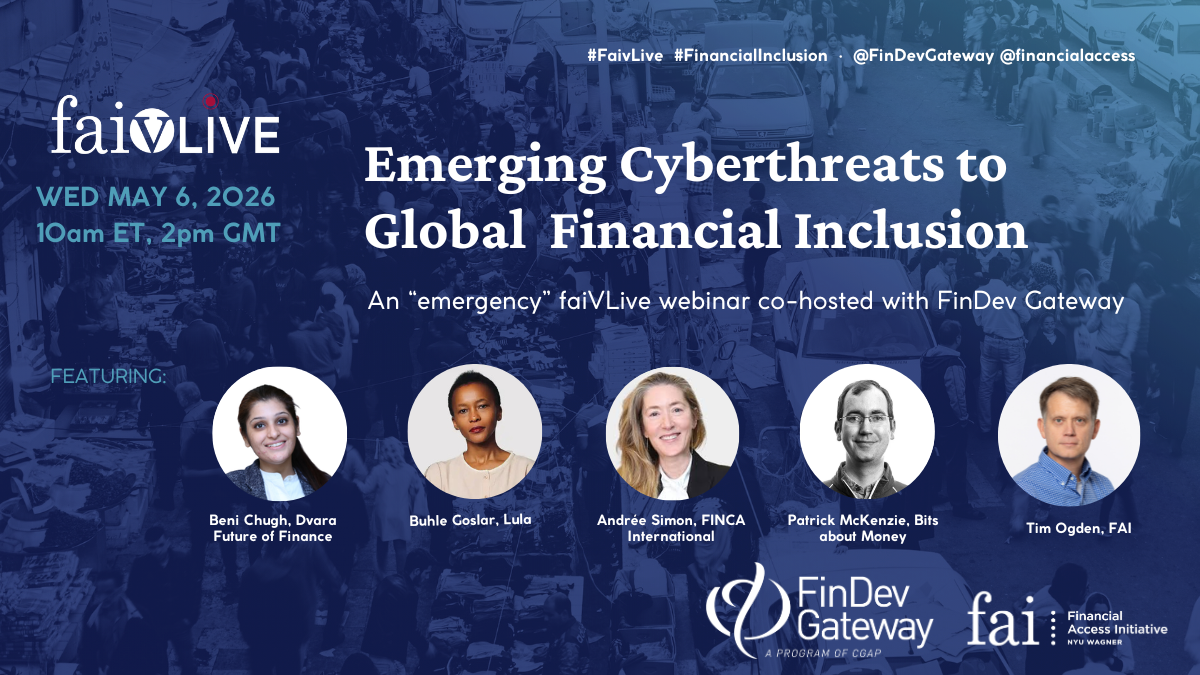
Increasingly powerful AI tools are enabling malicious actors to target financial services systems and institutions the world over. Recently the IMF found cyber-enabled fraud has nearly tripled with losses falling hardest on developing countries. And that was before a new generation of AI models powerful enough to spur an emergency meeting between the US Federal Reserve and the CEOs of the largest banks in the world. These emerging threats are in no way confined to large multinational banks however. AI lowers the costs of cyberattacks, increasing the number of organizations at risk including CDFIs in the US, MFIs around the world, mobile money systems and fintechs focused on lower-income customers.
Read MoreRegister Now: Small Firm Diaries USA Early Findings
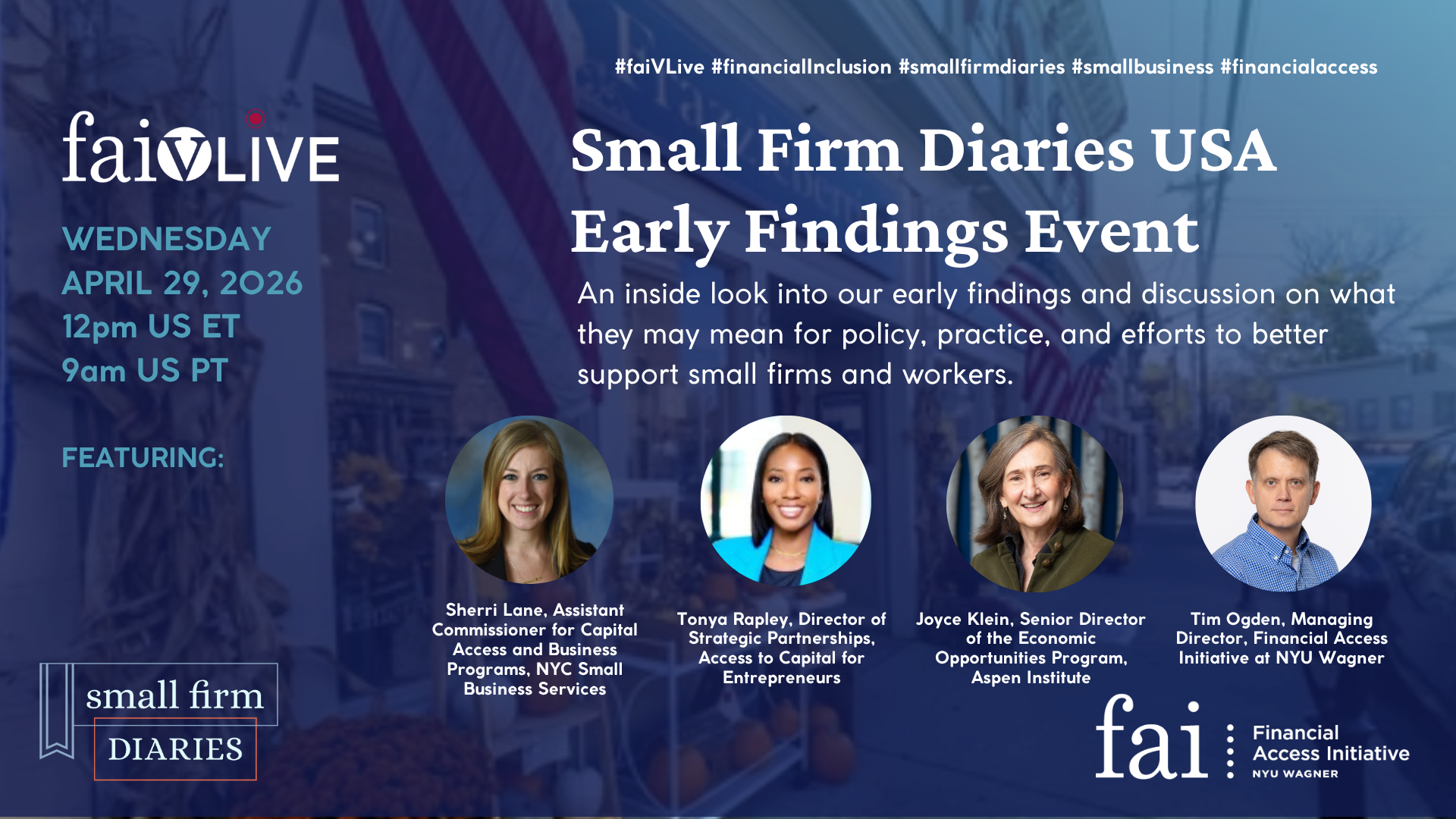
Since the launch of the Small Firm Diaries USA, our research team has been busy collecting data from more than 80 small firms, and we’re excited to share what we’re learning so far. By following firms in low-income communities over time, the research takes an unusually close look at the financial lives of small businesses to surface how business owners manage volatility, respond to shocks, and make decisions that shape their businesses and their workers.
Join us for an inside look into our early findings and discussion on what they may mean for policy, practice, and efforts to better support small firms and workers.
Read MoreRegister Now: Small Firm Diaries USA Early Findings
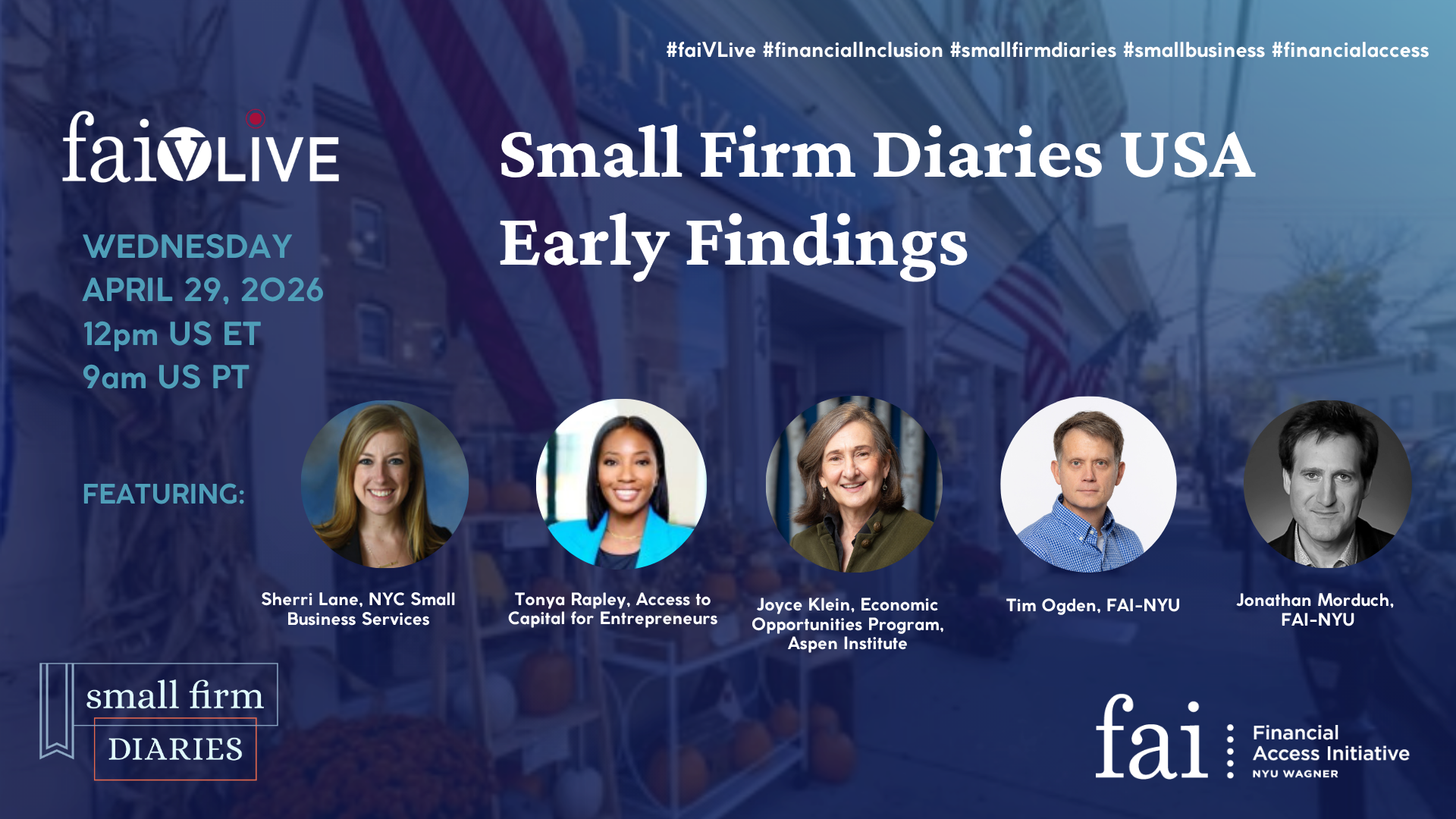
Join us for an inside look into our early findings and discussion on what they may mean for policy, practice, and efforts to better support small firms and workers.
Read MoreWhat’s at Stake Now for Small Business
On November 19, 2025, FAI hosted a faiVLive webinar to introduce the Small Firm Diaries USA study. We shared early observations, and talked with expert panelists about how recent policy and program changes are affecting small businesses and organizations that support them. In this blog we’ve adapted and edited a few of the most interesting discussion points from our conversation. You can still watch the full webinar, here.
Read MoreIntroducing Small Firm Diaries USA: An Innovative Study Focusing on Small Businesses in Low-Income Communities Amid a Rapidly Changing Landscape
In this webinar held on November 19 at 9am PT/12pm ET, we introduced The Small Firm Diaries USA—a new research initiative examining the daily financial realities, challenges, and resilience strategies of small firm owners and their workers. Through a discussion with expert panelists, we explored how the shifting U.S. business landscape—from policy changes to economic pressures—is affecting the smallest employer firms in low-income areas.
Read MoreAssessing the Future of Microfinance as a Development Tool: Continuing the Conversation
Co-hosted by the Financial Access Initiative (FAI) at NYU and FinDev Gateway, this faiVLive webinar held on October 3, 2024 continued our exploration of the present and future of microfinance in development policy and practice. We discussed pressing questions for funders, practitioners, and policymakers.
Read MoreSmall Firm Diaries Global Findings: What We Learned, What's Next
In this webinar coming up on March 27 at 10am EDT we’ll share some data and key findings from the Small Firm Diaries. We’ll talk about related research and initiatives from around the world. And we’ll discuss the implications for what’s next on the agenda. Don’t miss this chance to join in a live discussion of findings from this first-of-its kind research study.
Read MoreMicrofinance Meets Pandemic: Two Years Later, Two Years From Now
Two years ago we hosted a faiVLive on “the gathering storm” of the pandemic and the crisis it presented for low-income households and the MFI industry. It’s clear now the industry has endured the storm better than many (or at least Tim) expected.
Read MoreThe Financial and Digital Literacy Gap: It’s a Trap!
There’s no question that there are big gaps in financial literacy between the rich and poor, and between those included and excluded at every income level and in every country. As digital finance becomes more important, the gap grows and takes on added dimensions. No wonder that financial (and now digital) literacy programs attract attention and millions of dollars globally.
Read MoreThe Financial and Digital Literacy Gap: It’s a Trap!
Welcome to this month’s faiVLive webinar. Watch the recording on our YouTube channel here.
There’s no question that there are big gaps in financial literacy between the rich and poor, and between those included and excluded at every income level and in every country. As digital finance becomes more important, the gap grows and takes on added dimensions. No wonder that financial (and now digital) literacy programs attract attention and millions of dollars globally.
Read MorePart 2 on The Role of Digital Money in Financial Inclusion
Back for a second run, Tim Ogden and Jesse McWaters of Mastercard continued their conversation on digital money, and grappled with questions focused on applications of digital currency to advance financial inclusion, cybersecurity, and the interplay between regulation, consumer protection and innovation.
Read MorePart 1 on The Role of Digital Money in Financial Inclusion
In this edition of the faiVLive, the Financial Access Initiative’s Tim Ogden and Jesse McWaters, the Global Head of Regulatory Advocacy at Mastercard, explored basic frameworks for understanding the differences between the rapidly growing types of digital currencies. They covered new and evolving digital means of exchange, how they interact, and what that means for pro-poor financial inclusion.
Read MoreRegister Now | From M-Pesa to Dogecoin to the Digital Naira: The Role of Digital Money in Financial Inclusion

Join FAI’s Tim Ogden in conversation with Jesse McWaters, the Global Head of Regulatory Advocacy at Mastercard, to explore some basic frameworks for understanding the differences between the rapidly growing types of digital currencies. Through this session you’ll gain a better grasp of new and evolving digital means of exchange, how they interact, and what that means for pro-poor financial inclusion.
Read MoreBuilding an Inclusive Financial System
In 2009, FAI founder Jonathan Morduch was part of a group that determined “half the world is unbanked.” Ten years later, the latest Global Findex tells us that the world’s unbanked population has been nearly cut in half. A combination of focused public and private efforts, aided by technology advances, yielded massive, though uneven, progress. It’s worth celebrating the gains, but also reflecting on what is still left to do. What lessons have we learned from the last 20 years that can close the rest of the inclusion gap? Why has inclusion in wealthier countries stalled? What does the inclusion agenda leave undone? How can technology be part of building more bridges to excluded communities?
This edition of the faiVLive was based on a new report from the Aspen Institute’s Financial Security Program, Building An Inclusive Financial System, that tackles those questions and more.
Read MoreWhen is FinTech Pro-Poor?
In this edition of the faiVLive, with a group of expert panelists from around the world, we delve into the possibilities for FinTech to serve the poor and reduce inequality. Six years after McKinsey heralded “a new era of digital globalization,” what have we learned about when, and where, FinTech meaningfully advances inclusion, and when it creates a new (digital) divide? When does FinTech (in the words of Greg Chen of CGAP, during this edition of the faiVLive) build a bridge and when does it dig a moat?
Read MoreAccounting for the Gender Profit Gap
In countries across the world, women earn less than men. This is true not only for wage-paying jobs, but also for the earnings of micro and small businesses, which play a prominent role in most economies. Women-led businesses are less profitable than their male counterparts, have fewer employees, and are less likely to grow. In this webinar, we discuss what we have learned form research and experience that can help policymakers, financial service providers, and other organizations better meet the needs of women, and close gender gaps in small firms.
Read MoreHow Low-Income Households Save—And Can We Help?
This edition of faiVLive—co-presented with the Aspen Institute Financial Security Program, brought together researchers and practitioners to look at how short-term savings work and don’t work, with a particular eye to whether and how savings for low-income households can be boosted.
Servicios Financieros Digitales y la inclusión financiera en América Latina
La pandemia ha elevado el perfil de los Servicios Financieros Digitales (SFD), los cuales han permitido una distribución sorprendentemente rápida de los fondos de apoyo social, ofreciendo un camino para brindar servicios financieros de forma segura y a escala. Sin embargo, aún quedan asuntos importantes que considerar en cuanto al despliegue e impacto final de los SFD. ¿Quiénes están siendo excluidos? ¿Cómo podemos asegurarnos de que los nuevos actores y modelos empresariales incorporen las necesidades de las comunidades y los clientes de escasos recursos? Esta edición de faiVLive reúne a profesionales e investigadores expertos para abordar estas preguntas y debatir el camino a seguir para los SFD y la inclusión financiera en América Latina.
Con la participación de: Xavier Faz, Líder de Modelos Empresariales y Líder Regional de CGAP en América Latina y el Caribe, Barbara Magnoni, Presidente de EA Consultants y Co-fundadora de MeXCo Soluciones, Timothy Ogden, Director General de la Iniciativa de Acceso Financiero de NYU, Kiki Del Valle, Vicepresidente Sénior de Alianzas Digitales de Mastercard.
Moderador: Gabriela Zapata, Consultora de Inclusión Financiera y Salud Financiera.
Week of June 26th, 2020 (faiVLive)
This week’s faiV was a faiVLive — a webinar featuring a panel of experts discussing the future of digital financial services and inclusion.
Thanks to everyone who joined our faiVLive webinar about the future of Digital Financial Services on June 26th. If you weren’t able to join us live, you can watch a recording of the webinar through this link.
About the webinar:
The pandemic has raised the profile of digital financial services, which have enabled amazingly rapid distribution of social support funds and may provide a path forward for delivering financial services safely and at scale. But there are important questions left to consider about the roll-out and ultimate impact of DFS. This edition of faiVLive brings together expert practitioners and researchers to address these questions, ranging from the impact of DFS on MFIs to digital security.
Moderator:
Timothy Ogden, Managing Director of the NYU Financial Access Initiative
Featuring:
Tamara Cook, CEO, FSDKenya
Salah Goss, SVP, Government & Development, Mastercard
Moonmoon Shehrin, Digital Cluster Manager, Microfinance, BRAC
Gregory Chen, Lead Financial Sector Specialist, CGAP
Graham Wright, Group Managing Director, MSC
Support:
This faiVLive is supported by the Mastercard Impact fund, and in collaboration with the Mastercard Center for Inclusive Growth
SEARCH BLOG
STAFF PICKS
Editor’s Note: I’m going to assume that you are seeing plenty of AI content (news and papers, not AI slop, though I’m sure you’re getting plenty of that too) from other sources, so I’m trying to think hard about the marginal value that the faiV can provide. As far as I’ve gotten so far: a) make sure that directly AI-related content does not take up more than 2 of the 5 items, and b) try to focus specifically on the cybersecurity issue for financial inclusion. Beyond that, I’m open to feedback on the value you get from the faiV in relation to AI to help guide us in the future. On a different note, I’ll be making a brief cameo appearance at the e-MFP Inclusive Finance Conference to moderate the opening plenary. If you haven’t registered, do so and I hope to see you there! - Tim Ogden