




Join FAI’s Tim Ogden in conversation with Jesse McWaters, the Global Head of Regulatory Advocacy at Mastercard, to explore some basic frameworks for understanding the differences between the rapidly growing types of digital currencies. Through this session you’ll gain a better grasp of new and evolving digital means of exchange, how they interact, and what that means for pro-poor financial inclusion.
Read MoreViewing all posts with tag: Poverty
Accounting for the Gender Profit Gap
In countries across the world, women earn less than men. This is true not only for wage-paying jobs, but also for the earnings of micro and small businesses, which play a prominent role in most economies. Women-led businesses are less profitable than their male counterparts, have fewer employees, and are less likely to grow. In this webinar, we discuss what we have learned form research and experience that can help policymakers, financial service providers, and other organizations better meet the needs of women, and close gender gaps in small firms.
Read MoreHow Low-Income Households Save—And Can We Help?
This edition of faiVLive—co-presented with the Aspen Institute Financial Security Program, brought together researchers and practitioners to look at how short-term savings work and don’t work, with a particular eye to whether and how savings for low-income households can be boosted.
Servicios Financieros Digitales y la inclusión financiera en América Latina
La pandemia ha elevado el perfil de los Servicios Financieros Digitales (SFD), los cuales han permitido una distribución sorprendentemente rápida de los fondos de apoyo social, ofreciendo un camino para brindar servicios financieros de forma segura y a escala. Sin embargo, aún quedan asuntos importantes que considerar en cuanto al despliegue e impacto final de los SFD. ¿Quiénes están siendo excluidos? ¿Cómo podemos asegurarnos de que los nuevos actores y modelos empresariales incorporen las necesidades de las comunidades y los clientes de escasos recursos? Esta edición de faiVLive reúne a profesionales e investigadores expertos para abordar estas preguntas y debatir el camino a seguir para los SFD y la inclusión financiera en América Latina.
Con la participación de: Xavier Faz, Líder de Modelos Empresariales y Líder Regional de CGAP en América Latina y el Caribe, Barbara Magnoni, Presidente de EA Consultants y Co-fundadora de MeXCo Soluciones, Timothy Ogden, Director General de la Iniciativa de Acceso Financiero de NYU, Kiki Del Valle, Vicepresidente Sénior de Alianzas Digitales de Mastercard.
Moderador: Gabriela Zapata, Consultora de Inclusión Financiera y Salud Financiera.
Week of July 25th, 2020
Editor's Note: It's been a bit more than four years that I've been writing the faiV and though I probably haven't had as many links as minutes in a year, it's a safe bet that there have been more than 200 faiVs and 4000 links in that time. So I took a bit of an unannounced hiatus for the month. I hope you missed the faiV.
If you did, and you'd be interested in being part of a feedback panel that we are putting together to help us make decisions about the future of the faiV, please just respond to this email. And if you missed us but think the faiV is already perfect, feel free to respond to say that, but more importantly, please tell a few friends and colleagues to subscribe.
In public services announcements, there are a couple of research funding opportunities that may be of interest to you: a) UNESCAP has a new RFP for evidence-based interventions to support women entrepreneurs (in Bangladesh, Cambodia, Fiji, Nepal, Samoa, or Vietnam); and b) ANDE and the Canadian IDRC have a call for Expressions of Interest on studying the experiences of women in venture accelerators in Latin America and SSA.
--Tim Ogden
Read MoreDigital Financial Services, Inclusion, Exclusion and the Future of Pro-Poor FSPs
The pandemic has raised the profile of digital financial services, which have enabled amazingly rapid distribution of social support funds and may provide a path forward for delivering financial services safely and at scale. But there are important questions left to consider about the roll-out and ultimate impact of DFS. This edition of faiVLive brought together expert practitioners and researchers to address these questions, ranging from the impact of DFS on MFIs to digital security.
Read MoreWeek of October 18, 2019
1. Nobel Prizes: It's a little weird writing about the Nobel going to Banerjee, Duflo and Kremer in the faiV--this is mostly stuff we cover all the time, and it's probably not news at this point to anyone who cares. So it's not entirely clear what to write. But here goes.
First, I have to point out that 1 in 5 people I interviewed for my book have gone on to win a Nobel. So any of you who aspire to future laureate status should probably make time for me (Yes, I'm talking to you Sendhil). All I'm saying is that both an event study or an RDD would show strong indications of causality. Given that my ability to predict the winner of the prize also is remarkable, wouldn't you say now is a great time to recommend subscribing to the faiV to all of your friends?
More seriously, I suppose I should link to some of the responses. From the "pro" camp here's Karthik Muralidharan and here's Pam Jakiela who notes that Esther is the first woman with an economics Ph.D. to win (Elinor Ostrom's Ph.D was in political science) while also noting the quite different family structure of this set of winners in comparison to many in the past (though not, it should be noted, the other Nobelist who won after appearing in my book, Angus Deaton). Here's Tim Harford, who unusually, quickly shifts the focus to Kremer's O-ring theory. On the more neutral side, here's Maitreesh Ghatak.
There's a critical side as well. For example, here's Duvendack, Jolly, Mader and Morvant-Roux on how the prize reveals the "poverty of economics." And here's Grieve Chelwa and Sean Muller with "the poverty of poor economics." I have serious issues with both of these. The Duvendack et al. piece seems to intimate that Esther and Abhijit were pro-microcredit and tried to rescue the sectors reputation from their unexpected results. That is just bizarre--the title of their paper "The Miracle of Microfinance" could be better described as an intemperate twisting of the knife; that's certainly how the microfinance industry felt. Chelwa and Muller accuse the randomistas of "imitating" science but not doing it--which can only mean they are paying very little attention to what happens in other domains of science. Here's a Twitter thread of response to Chelwa and Muller from Oyebola Okunogbe. As Okunogbe points out while pushing back, each of the essays make some good and reasonable points, which is part of what makes the critiques of the RCT movement so maddening: the blending of good points with silly ones blunts the impact of the critics, in my opinion.
Now if you're interested in a long and more balanced, but still critical (in the better, broader sense) take, here's Kevin Bryan's overview at A Fine Theorem.
The next big question for me is what comes next for the RCT movement and it's critics. There are several possible futures. One is that the prize permanently solidifies the value of RCT movement and allows more constructive engagement by proponents with critics since the randomistas no longer have to worry about an existential threat to their work and legacy. Another is that the critics will realize that their long rearguard campaign against the movement has been lost, and rather than devoting energy to grand sweeping critiques of the movement as a whole, will focus on more specific critiques of individual studies, designs, interpretations and findings and the application of research to policy, yielding better overall outcomes. And of course, there is the possibility that this changes nothing and we'll be still be having these same conversations about the use or uselessness of randomized trials in development economics 10 and 20 years from now.
2. Migration: It's here, at long last. Something like 7 years ago, I was talking with Michael Clemens about households, finances, migration and remittances. We got ourselves in a good dudgeon about the way most research approached remittances and agreed we should write a paper about re-conceiving migration as an investment and remittances as a cash flow return on that investment. It took us, I think, about 2 years to actually write the thing. That version turned into a couple of Lego stop motion videos--it was a weird time in the development internet back then--and we submitted it to a journal. Then, 5 years later we got a response. I'm not kidding.
But there's a happy ending. We were invited to revise and update (there was of course a lot to update after 5 years) and re-submit. And this week the finished product is finally published: Migration and Household Finances: How a Different Framing Can Improve Thinking About Migration (though I'll keep thinking of it as "Migration as a Household Finance Strategy").
And since Michael is so prolific on questions of migration, here's a thread from this week, with papers, on the old argument that physically coercing people to stay where they are is justifiable. (Spoiler: it's not).
3. US Inequality: Since the US Financial Diaries, a common refrain around here has been the hidden dimensions of inequality in the US--not just the easily quantifiable things like income or wealth, but the life and work circumstances that amplify and entrench income and wealth inequality. Things like irregular work schedules.
Kristen Harknett and Danny Schneider have been investigating the prevalence and impact of irregular work schedules for a few years. Earlier this year they had a paper about the consequences of irregular schedules on worker health and well-being. They have a new report out on how schedule irregularity "matters for workers, families and racial inequality." Here's an overview of their whole research program with links to other papers, and a very consumable summary from the Center for Equitable Growth.
I mentioned the strange times a few years ago as we all struggled with how to use the tools the internet was serving up to us to better communicate research and ideas. I have to say I'm impressed by the what is in evidence here in the partnership between Harknett and Schneider and the Center for Equitable Growth to get these ideas out through multiple channels.
On not just a US inequality note, I'll be at the Global Inclusive Growth Summit hosted by the Mastercard Center for Inclusive Growth and the Aspen Institute on Monday and a Center event on driving financial security at scale on Tuesday. If any faiV readers will be there, be sure to say hello.
Week of September 13, 2019
1. Digital Finance: Is a tide turning on digital credit? Old hands in the microfinance world like MicroSave and CGAP have been highlighting concerns about digital credit for the last few years, but the non-specialist community hasn't seemed to notice until recently. In late August Bloomberg had a quick hit piece with an eyebrow-raising headline, "This Nobel-Prize Winning Idea is Instead Piling Debt on Millions," which is likely the way the general public will perceive this despite the protests of insiders that telecoms/fintechs making instant loans at high rates with minimal customer engagement doesn't have much in common with traditional microcredit. A more serious treatment,"Perpetual Debt in the Silicon Savannah" was published in the Boston Review the same week, though it's frustrating in its own ways, notably the lack of engagement with the global/historical context of small dollar lending or with the research from financial diaries.
In both articles there are two additional issues that I wish received more attention. First, the value of liquidity management. The authors of the Boston Review piece, Emma Park and Kevin Donovan (both historian/anthropologists), spend a good deal of time talking about the "zero-balance economy" creating a situation where consumers can be exploited without engaging on the need for services to manage liquidity when you have low and volatile incomes. Second, the kind of default rates being hinted at in these articles raise serious questions about the business models and sustainability of digital lenders. Tala, one of the larger digital credit providers in Kenya (and elsewhere) just raised another $110 million. How much of that money is covering losses? I would love to see some analysis of what sustainable default rates are for digital credit.
Shifting gears a bit, the reason that the Kenya specifically and East Africa more generally remain in the spotlight on digital finance is the ubiquity of access. But ubiquity can't be assumed and in general I would say not enough attention is being paid to what happens when ubiquity fails. Here I don't mean places where everyone knows service is unreliable, but places and times where service is unexpectedly unavailable. Here's a story about the problems that can create in the US with ZipCar customers stranded in the "wilderness" because of a lack of signal leaves them unable to unlock or start the vehicles. More seriously, though, is the concern when access is limited because of political reasons. Here's a story about the rise in government-directed internet shutdowns. Of course there is the big concern of how these shutdowns would affect people who have adopted digital finance and find themselves unable to spend. But I also wonder if Tala investors have priced in the risk to the business model of internet shutdowns.
Internet shutdowns are a blunt tool. We should also be concerned about more fine-grained tools in the hands of governments or private companies. I'm old enough to remember when one of the highlighted "benefits" of digital finance was that it created an audit trail of transactions. Here's a story about how much data about you leaks to unknown parts of the internet when you use the Amazon Prime card and the Apple Card. And finally, here's a new report on cash as a public good from IMTFI, sponsored by the International Currency Association, which I am fascinated to discover exists (though I'm even more fascinated to discover the International Banknote Designers Association, which is one of its members).
2. Our Algorithmic Overlords: There is of course a lot of overlap between concerns about digital finance and privacy and digital everything and privacy. One of the standard mantras of those gathering and selling data is that much of it is anonymized, so we shouldn't be concerned. But, of course, not so much. That's not just a concern in the US, because digital data-gathering is becoming a thing worldwide. Here's a plea to stop "stop surveillance humanitarianism." And here's a story about how a high-tech surveillance approach to improving disaster response turns out to have not been such a good idea (spoiler: garbage in/garbage out).
One of the major concerns about the use of algorithms in these situations is the garbage in/garbage out problem--combined with the gee-whiz veneer that technology provides obscuring that problem. I'm generally skeptical of that argument as a whole, because my experience is that people are far less likely to trust an algorithm than a human being (In some sense I wrote a whole book about it in a different application: the bogus fears that Toyotas were suddenly accelerating and trying to kill people). But there are other forms that algorithmic discrimination can take. Here's a story about a new US Housing and Urban Development regulation that would exempt landlords from responsibility for the discriminatory results of their screening practices as long as they don't understand the algorithm, which y'know is a given.
Finally, there is a new documentary about the 2016 US election, the Brexit referendum, Facebook/Cambridge Analytica, etc. called The Great Hack. Here's a piece about 7 things the documentary gets wrong which I find pretty convincing.
Week of July 12, 2019
1. Research, Evidence, Policy and Politicians: We talk a lot around here about evidence-based policy and often about the political economy of adopting evidence-based policies. In the last faiV I featured some of the first evidence that elected officials (in this case 2000+ Brazilian mayors) are interested in evidence and will adopt policies when they are shown evidence that they work.
Far be it from me to let such encouraging news linger too long. Here's a new study on American legislators (oddly also 2000+ of them) that finds that 89% of them were uninterested in learning more about their constituents opinions even after extensive encouragement, and of those that did access the information, the legislators didn't update their beliefs about constituent opinions. Here's the NY Times Op-Ed by the study authors.
But wait, there's more! In another newly published study using Twitter data on American congresspeople, Barera et al. find that politicians follow rather than lead interest in public issues. But also that politicians are more responsive to their supporters than to general interest. Which perhaps goes some way to explaining the seeming contradictions between these two studies: American legislators are not interested in accurate data on all of their constituents' opinions, but will follow the opinions of their most vocal supporters.
2. Research Reliability: Two studies of the same population finding at least nominally opposing things published in the same week is kind of unusual, shining a brighter light on the question of research reliability than there normally is. But there have been plenty of other recent instances of the reliability of research being called into question for lots of different reasons:
* The difference between self-reported income and administrative data: the widely known finding that Americans living in extreme poverty (below $2 a day) was based on self-reported income. Re-running that analysis with administrative data that presumably does a better job of capturing access to benefits and other sources of income and wealth finds that only .11 percent of the population actually has incomes this low, and most are childless adults. Here's a Vox write-up of the findings and issues.
* A "pop" book on marriage from an academic claimed that most married women were secretly desperately unhappy. But that's because he misunderstood the survey data, believing that the code "spouse not present" meant that the husband was not in the room when the question was answered, when it really means that the spouse has moved out. Again, Vox does some good work explicating the specifics and the context: most books aren't meaningfully peer reviewed.
* But you probably should be very skeptical of any research on happiness regardless of whether it's peer reviewed because "the necessary conditions for...identification..are unlikely to ever be satisfied."
* And you should be skeptical of many papers studying the persistence of economic phenomena over time, and spatial regressions in general because of the possibility of inflated significance that is really just noise.
* You should also perhaps be skeptical of any claims based on Big 5 personality traits outside of WEIRD countries because the results are not stable across time or interviewers.
* And there are still a lot of issues with the applications of statistical techniques across the social sciences, including, for instance, the misapplication and misinterpretation of RDD designs, or conditioning on post-treatment variables (that's a paper from last year that finds 40% of experiments published in top 6 Political Science journals show evidence of doing so), or using estimated effect sizes to do ex post power calculations.
* Or this Twitter thread about a series of papers published in top medical journals that defies description, other than you really have to read it.
It's enough to make you despair.
Week of March 1, 2019
1. Economics: The dismal science doesn't often generate positive reviews from outside the discipline, so when it does happen it's worth noting. Julia Rohrer, who in addition to having one of the best titled blogs I've ever seen, is a psychology graduate student who procrastinated on her dissertation by attending a summer program in economics. Here is her list of things she appreciated in economics as a positive contrast to her experience in psychology.
On the other hand (hah!), economists typically have a lot to say about what is wrong with economics--certainly I encounter more "friendly-fire" in the econ literature than when I dip my toes in other disciplines (though this is perhaps my favorite example of the intra-disciplinary critique). There's an ongoing discussion about the future of economics going on in the Boston Review--I don't know if that counts as friendly-fire in terms of the outlet, but the participants are economists--starting with an essay by Naidu, Rodrik and Zucman, Economics after Neoliberalism. Then there are responses from Marshall Steinbaum, who notes that "every new generation proclaims itself to have discovered empirical verification for the first time," and from Alice Evans who focuses on the nexus of economics and political power in the form of unions.
But, because it's me writing this, I have to close on a new paper in JDE, that finds that communal land tenure explains half of the cross-country agricultural productivity gap. And here's a piece about how small teams of researchers are more innovative than large teams. generate much more innovation than big teams Neo-liberalism won't go down without a fight!
2. Migration: I haven't touched on migration for a while so it felt serendipitous that Michael Clemens and Satish Chand put out an update to their paper first released in 2008(!) on the effects of migration on human capital development in Fiji. The basic story is that in the late 80's formal discrimination against Indian-Fijians increased sharply, causing the community to both increase emigration and investment in human capital to aid emigration prospects. The net effect, rather than the dreaded "brain drain," was to increase the stock of human capital in Fiji. grapes
Cross-border migration is really the only option in Fiji, but in many countries, like Indonesia, there are lots of internal migration options. Since there is typically a large gap in productivity within countries as well as between countries, internal migrationhas always been a part of the development story. Bryan and Morten have a new article in VoxDev about this process in Indonesia, looking at the productivity gains possible from removing barriers to internal migration.
Since we started off talking about Economics, here's a post from David McKenzie considering the effects of migration on economists--or more specifically, how to think about job market papers about a candidate's country-of-origin. True to his style, David goes deep, including a model, and a survey. The post was inspired by a tweet from Pablo Albarcar who later noted it was mostly a joke about "brain drain" worries.
It is surprising to me how tenacious the brain drain idea is. When I have conversations about it, I try to cite the literature like Clemens and Chand, but I rarely find that makes a dent. People can always find an objection. So I've taken to just asking people how they feel about the "destruction" of Brazilian soccer/football culture and skill due to the mass emigration of the most skilled players. Typically, that leads to several moments of silent blinking. If you're interested here's a paper about "Rodar" the circular human capital investment, migration and development among Brazilian footballers.
3. US Poverty and Inequality: I typically try to avoid the grab-bag approach to items of interest but I'll confess this one is a bit of a grab bag with a variety of connecting threads. We'll start by connecting to a piece I included last week about tax refunds and saving. If you haven't read that, you should. I noted I was grateful for the piece because it meant I could skip the annual ritual of linking to a piece I wrote for SSIR several years ago about rethinking tax refunds. But I should have known that the zombie idea of tax refunds being bad personal finance wouldn't die so easily. Here's Neil Irwin from the NYT on how people being angry about lower refunds shows that "humans are not always rational." I'm struck by the irony that the continuing common use of "rational" in economics requires zero-cost attention, while a foundational truth of the discipline is "nothing is zero-cost." There is nothing irrational about paying a very small fee (in foregone interest) for the valuable service of helping you to save when other services are ineffective. That's especially true if you include, as you should, the cost of the tax advisors and financial advisors required to accurately calculate the proper amount of withholding and to choose the right investment/savings account in which to store those savings. So I guess that connects to the thread about economics maybe not being post-neoliberalism quite yet. And here's a column from the Washington Post's personal finance columnist withpush back on the "refunds are bad" idea from readers who explain their rational choices in their own words.
Week of December 10, 2018
1. Targeting: I intended for the faiVLive conversation to spend more time on targeting than we did--it's a sort of rushed conversation at the end. Targeting is something that I've been thinking about a lot, but I'm not sure what I think yet. So forgive me for just ruminating on a few things here.
The whole concept of microcredit is based on targeting--every lender has to target not only those interested in taking a loan but those interested in repaying a loan. Hand-in-hand with targeting repayers was targeting borrowers who were "entrepreneurs," people who would start a business, since the belief was a new microenterprise was the only plausible way for these very poor households to repay. But since the rhetoric emphasized that the poor were natural entrepreneurs, targeting repayers substituted 1:1 for targeting entrepreneurs. Given the findings of microcredit impact studies--namely that while average impact is minimal, there are people who see large gains--the focus on targeting has returned. See for instance, asking middle men who the best farmers are, or surveying other microenterprises.
But if your aim is reducing poverty, then you have to care about more than just finding the borrowers who will repay and have the highest returns on capital--you have to care about equity as well and the effect on, or exclusion of, the poorest or least able to generate high returns. Earlier this year I linked to a paper by Hanna and Olken on the equity effects of targeted transfers vs. UBI. Here's an interview with the two that summarizes their findings: for most poor countries, targeted transfers far outperform a UBI in terms of total welfare. And by the way, here's new Banerjee et al paper from Indonesia showing limited distortions from proxy-means tests.
Of course, in targeting microcredit we are doing the opposite essentially: looking for a proxy-means test to exclude the least-able to generate high returns. What effects might that have? If we boost market efficiency, it could be good for most everyone. That's not just theoretical--here's an empirical finding from Jensen and Miller on improving market efficiency in Kerala boat-building finding higher aggregate quality, lower production costs and lower quality-adjusted prices. But maybe not. That paper above on using middle-men to target finds that traditional allocation of loans does better for the poorest. And as we discussed on the faiVLive conversation, there can be systematic differences in market structure that limits who can generate high returns (in this case, among women seamstresses in Ghana). It's why I worry about what exactly is being measured in targeting algorithms like EFL/Lenddo.
The possible gains and losses have to be measured against the cost of targeting. The cost of microcredit as it exists, without targeting, is pretty low. The median subsidy per loan is about $25, not much for spreading access to the liquidity management features of microcredit well beyond those with high returns to capital. And then there is reason to think about the effect of greater targeting on the microfinance business model. Here is one of the few economics papers to make me actually angry, suggesting that microcredit contracts were purposefully designed to limit the growth of borrower's businesses. While I wholly reject that claim, the underlying idea is worth considering: microcredit's low relative costs are based on a mass-lending business model and MFIs have largely failed to find a way to compete higher up the banking value chain. Altering that business model could have unintended consequences. That's not just based on that paper. As I mentioned last week, City of Debtors, a book about small sum lending in New York City during the 20th century confirms the business model problem is real and pervasive.
So I don't really know what I think. I'll keep thinking about it, but as always I appreciate your thoughts if you're willing to share them.
2. US Inequality: I haven't covered US Inequality for several weeks, and so things have been building up. And there's been a whole lot of new stuff in the last few weeks. Let's start with the state of median US income over the last 30 years. The widely held current view is that incomes for all but the top quintile or decile have been stagnant. But that's heavily dependent on all the adjustments that need to be made for taxes, transfers, inflation and innovation. Stephen Rose at the Urban Institute summarizes the past and new work trying to measure changes in median income, and then writes in more detail about the methodological issues. One thing that had particularly slipped by me: Picketty, Saez and Zucman have a newish paper updating the famous results that showed stagnation and find median incomes have increased about 30% over the last 30 years. That shifts the proportion of gains by the top decile from around 90% to around 50% (I'm intentionally rounding these numbers because they are so sensitive to methodological choices, that I think we're all better off not reporting precise numbers because of the illusion of certainty that goes along with them). Perhaps one of the reasons that these new findings didn't seem to get as much attention as the idea of stagnation for the middle class, is that the new paper also finds that stagnation is true for the bottom 50% of the income distribution.
This week the US Census also released it's "Small Area Income and Poverty Estimates" for 2017, with county-level data on incomes and poverty rates. They find that over the last 10 years, median incomes in 80% of US counties were unchanged, with 11% of counties seeing an increase and 8% seeing a decrease. When you look at the maps, it's apparent that a majority of the counties seeing an increase are related to the fracking boom (and thus mostly in places with very few people). On the poverty front, there's a whole lot of stagnation too, with almost 90% of counties seeing no change, but 8% seeing an increase and only 3% seeing a decrease. Not an encouraging picture.
Whenever you talk about incomes and poverty, it's worthwhile to think about the definition of poverty. Here's Noah Smith on updating the definition of poverty to include volatility (though he shockingly fails to mention the US Financial Diaries). And here's Angus Deaton on "How America poverty became fake news"--with some more methodological detail and the horrid engagement of the present administration with international attempts to measure poverty.
There's plenty new on the policy front as well. Here's a new paper estimating the total budget effect of the EITC--finding that the program self-finances 87% of its cost by reducing use of other transfer programs and increasing taxes collected. And here's The Hamilton Project on the work histories of people receiving SNAP and Medicaid benefits, finding that the majority are working, but irregularly and a substantial portion would "fail to consistently meet a 20 hour per week-threshold" because their hours worked vary so much from week-to-week.
Week of October 15, 2018
1. China: This is a very meta way of kicking things off, but I do think often of the gaps in knowledge that go along with the language gap between centers of academic inquiry and China (and to a lesser extent, India, Indonesia and Nigeria). It takes a lot of cognitive work to push back against the unconscious equation of value/quality with English-language facility, and that's just for the papers and stories that ever do appear in English (thank goodness for Jing Cai!). Anyway, here's a small attempt to address some of the knowledge gap.
The P2P lending industry in China continues to melt down in very scary ways, and in ways reminiscent of bank runs in the US around railroad bubbles in the late 19th century. The common ingredients--a working class population with enough income to start seriously saving and limited outlets for saving/investing and even more limited consumer protections. It's ugly and getting uglier as the authorities crack down on both the lenders and protestors who have lost their savings.
But that's not the only credit market problem in China. The head of a very large state-backed lender was pushed out of the party for corruption (and he's not the first and likely not the last). Meanwhile, local governments have been creating weird vehicles to borrow via private (or are they public? it's hard to know what's the right phrase to use when it comes to China's hybrid economy) markets. Current estimates suggest there is a $5.8 trillion dollar local government credit problem. Amidst the trade war, the Chinese economy seems to slowing just at the time these credit market problems are coming to light--I don't see anything in these stories about a causal effect--and there are other signs of bad news. If you are a Planet Money listener, you may recall a recent story about a rumored "vast postal conspiracy" that largely checked out. This week the Trump administration announced that it is withdrawing from the Universal Postal Union, a system that was set-up for the US' benefit post-WWII but became a huge boon to small Chinese manufacturers. Planet Money's "The Indicator" also did a series recently on China's social credit scoring system, including talking with someone who has been blacklisted.
Finally, here's a story to lead us into the next item: accusations of racism by Chinese firms are becoming increasingly common in Kenya and other African countries were China has been investing heavily.
2. Global Development: The gap (particularly the growth gap) between high-income and low-income countries is what the field is all about, indeed "it's hard to think about anything else." The gap has been stubbornly high and growing since World War II. Dev Patel, Justin Sandefur and Arvind Subramanian have a new post at CGD, reacting to a new paper about the lack of convergence, pointing out that cross-country convergence has been happening since 1990. The authors of the paper respond on Twitter.
There's a curious connection that back when many of the original ideas of development economics posited that convergence should happen--e.g. poorer countries should grow faster than richer ones--while recognizing that it wasn't happening, one of the prescriptions was a "big push" to help poor countries escape a poverty trap. The idea of the big push eventually went into hibernation, but was revived around the time that the convergence did start happening (though we didn't know it yet). This time the big push was at the village level, not the country level. It didn't work any better there. Last week, the results of "the first independent impact evaluation" of Millenium Villages Project (of a village in Ghana) were released and the bottom-line is scathing. There was no gap-closing here--the only positive effects found, the study notes, could have been accomplished at dramatically lower cost. On a similar note, here's a look at another MVP-project village, Sauri, Kenya, and finding that locals did not believe in the benefits of MVP enough to bid up the prices for land in the village. Which honestly is kind of remarkable given all the money that was showering into the villages. You would think people would want to move there simply to benefit from the opportunities for corruption/patronage.
Finally, here's a really fascinating example of a growing gap--the gap in gender preferences grows with economic development and gender equality. This definitely feels like an "everything is obvious once you know the answer" example.
Week of September 24, 2018
1. Poverty and Inequality Measurement: How do you measure poverty, and by extension, inequality? Given how common a benchmark poverty is, it's easy to sometimes lose sight of how hard defining and measuring it is.
Martin Ravallion has a new paper on measuring global inequality that takes into account that both absolute and relative poverty (within a country) matter--for many reasons it's better to be poor in a high-income country than a low-income one, which is often missed in global inequality measures. Here's Martin's summary blog post. When you take that into account, global inequality is significantly higher than in other measures, but still falling since 1990.
The UK has a new poverty measure, created by the Social Metrics Commission (a privately funded initiative, since apparently the UK did away with its official poverty measure?) that tries to adjust for various factors including wealth, disability and housing adequacy among other things. Perhaps most interestingly it tries to measure both current poverty and persistent poverty recognizing that most of the factors that influence poverty measures are volatile. Under their measure they find that about 23% of the population lives in poverty, with half of those, 12.1%, in persistent poverty.
You can think about persistence of poverty in several ways: over the course of a year, over several years, or over many years--otherwise known as mobility. There's been a lot of attention in the US to declining rates of mobility and the ways that the upper classes limit mobility of those below them. That can obscure the fact that there is downward mobility (48% of white upper middle class kids end up moving down the household income ladder, using this tool based on Chetty et al data). I'm not quite sure what to make of this new paper, after all I'm not a frequent reader of Poetics which is apparently a sociology journal, but it raises an interesting point: the culture of the upper middle class that supposedly passes on privilege may be leading to downward mobility as well.
There's also status associated with class and income. On that dimension, mobility in the US has declined by about a quarter from the 1940s cohort to the 1980s cohort. That's a factor of "the changing distribution of occupational opportunities...not intergenerational persistence" however. But intergenerational persistence may be on the rise because while the wealth of households in the top 10% of the distribution has recovered since the great recession, the wealth of the bottom 90% is still lower, and for the bottom 30% has continued to fall during the recovery.
2. Debt: What factors could be contributing to the wealth stagnation and even losses of the bottom 90% in the US? Just going off the top of my head, predatory debt could be a factor. If only we had a better handle on household debt and particularly the most shadowy parts of the high-cost lending world. Or maybe it's the skyrocketing amount of student debt, combined with bait-and-switch loan forgiveness programs that are denying 99% of the applicants. I'll bet the CFPB student loan czar will be all over this scandal. Oh wait, that's right, he resigned after being literally banned from doing his job.
Week of September 3, 2018
1. Social Investing: Calling out the bland and meaningless rhetoric in social and impact investing almost seems unsporting--it's just too easy but it's Friday after a long week so I'm going to do it anway. Take this piece from John Elkington, who coined the term "triple bottom line," (Please), saying it's time to "rethink" or "recall" or "give up on" it (all his phrases). Why? Because the term has been misunderstood and misappropriated for uses well short of what he intended. Instead he thinks we need "a triple helix for value creation, a genetic code for tomorrow’s capitalism." But apparently not a clear definition or a recognition of trade-offs under scarcity.
Then there's this piece from the Wall Street Journal on the meaninglessness of words like "ethical", "impact" and "sustainable" in the mutual fund world. It's a treasure for the sheer density of laugh out loud snippets. For instance, Deutsche Bank switched out the word "dynamic" in the title of a family of funds and replaced it with "sustainable." Vanguard's bar for a company being "socially responsible" is literally not enslaving people or manufacturing weapons banned by international treaty. But my favorite is probably this quote about buyers of "ESG" funds: "We do hear from investors that have bought funds that they never realized did something." (Protip for non-WSJ subscribers who may not otherwise take the trouble to read this gem, search the title in an incognito window, click on the result link and close the invitation to subscribe and you'll be able to read it.)
2. Household Finance, Part I, Theory: Not realizing that funds did something is a good transition to Matt Levine's musings about the relationship between financial services providers and customers (scroll down to "How much should an FX trade cost?"). Matt is writing specifically about investment and corporate banking but the theory fully applies. In short, 'smart' large customers treat banks like commodity providers and ruthlessly push margins toward zero. Banks have to go along because these are large customers and economies of scale matter in financial services. So the banks make up those margins by charging 'loyal' customers much more than 'smart' customers. Which is, shall we say, not what 'loyal' customers think the banks should be doing and they rightly get very angry when they find out. So loyal customers should be more like smart customers and treat banks like commodity providers. The application of faiV interest is the Catch-22 for lower-income households: they only very rarely have the time and choice to treat financial services like a commodity, so they are almost inevitably left subsidizing wealthier customers. And even banks with good intentions struggle to do otherwise, because if you don't have the large customers, you can't drive costs down through scale.
In other theory news, one of the common motivating theories on helping low-income households is helping them plan. Planning is hard when facing scarcity. There's been encouraging evidence of the value of specific planning for getting people to follow through on their intentions. Here's a new paper testing the value of planning for one of the only two intention-action gaps that can rival the intention-action gap on savings: exercise (the other being dieting). It finds that careful detailed planning of an exercise routine has a precisely zero effect on follow-through.
Finally, here's a piece that at face value seems to be talking about the empirical transition away from cash (in the US). But look closely and it's really musing on the theory about the costs of cashlessness for lower-income households, something that deserves a lot more attention, on theory and empirics, than we seem to be getting right now. And it features Lisa Servon and Bill Maurer so you should definitely click.
3. Household Finance, Part II, Practicum: I don't remember how I stumbled across this paper about how US households respond to high upfront medical costs. It's not new, but it was new to me, though I suppose you can also say it's very old to anyone who has paid attention to healthcare consumption in low-income countries. The authors find a large decrease in spending, but no evidence that households are price shopping or making any differentiation between high-value and low-value services. Something to think about--how much of what we call "shocks" for low-income households are actually "spikes" that they didn't have the tools and bandwidth to manage (liquidity) for?
Week of August 27, 2018
Editor's Note: I'm still playing catch-up this week, and perhaps you are too. It's the "end of summer" in the Northern Hemisphere after all, that week we all get to, in a panic, confront all those things we had put off to the Fall AND all those things we thought we would get done during the "less busy" summer. Catching up notwithstanding, this is a somewhat truncated edition of the faiV, as I head into a weekend of labor related to the above.--Tim Ogden
1. Small Dollar Financial Services: I've been doing a lot of reading the last few weeks about the history of consumer banking (Hi Julia!), and by history I mean going back to the Middle Ages and before. From that reading, it's clear that small dollar lending has always been the bane of the banking system--and there is nothing new under the sun (thanks, David Roodman!). Which certainly colors my view when I see stories about overhauling the overdraft system in the US. Not that I don't think there is room for significant improvement. Overdraft is perhaps the worst possible way to manage small dollar lending--by pretending it's something else while still charging exorbitant fees that would make many microfinance institutions blush. There are plenty of ideas, like this story on a non-profit payday alternative lender which charges roughly half the fees of its competitors. The intent of the story seems to be offering this as a real alternative, but the details keep getting in the way. The nonprofit really is nonprofit in the literal sense of the word, not even being able to pay its CEO a $60,000 per year salary regularly, and facing "four near-death experiences" in 9 years--that sounds about par for the course in small dollar lending from the historical record.
2. Algorithmic Overlords: Yuval Noah Hariri has a new piece in the Atlantic, the title of which is just candy-coated confirmation bias for me, so how could I resist putting it in the faiV: "Why Technology Favors Tyranny". I'm feeling validated that I started reading Asimov's I, Robot to my kids this week. But back to Hariri, two thoughts: a) borrowing a category from Tyler Cowen, this is a very interesting sentence: "At least in chess, creativity is already considered to be the trademark of computers rather than humans!", and b) the picture Hariri paints bears a remarkable resemblance to the Allende plan in Chile specifically, and to almost every example in Seeing Like A State, it's just that the technology is finally catching up to the political ideology. The big question, of course, is whether the technology will yield any better results.
One more item I couldn't resist is this piece about blockchain and supposed complacency toward technological innovation in development. The most important thing to know is that the two examples given of the benefits of a decentralized ledger (e.g. blockchain) are two of the most centralized and highly policed ledgers in existence: SWIFT and Visa payment networks. It continues with a few potshots at small dollar fintech lenders and then some ersatz blockchain evangelism about power to the people. Let's hope the author reads many of the pieces linked above, but especially Hariri's. And just because, here's a story about the very first blockchain hiding in an ad in the New York Times in 1995.
3. Methods and Evidence: You've likely seen the uproar over ridiculous nutrition studies (on alcohol and dairy--clearly the message is to only drink dairy-based cocktails this weekend) this week. I saw someone on Twitter commenting on how the credibility revolution seems to have passed right by nutritional epidemiology, probably because it would mean that no studies ever got published.
Part of the credibility revolution is the emphasis on open data and replication. Here's a report on the latest large scale replication effort (of 21 social science studies published in Nature and Science). Thirteen of the 21 were generally replicated, but the effect size was roughly half of that originally reported. Of course, this raises the question of what "successful replication" means again. Here's a Twitter thread from Stuart Buck of the Laura and John Arnold Foundation on the difficult distinction between failed replication being a part of the scientific learning process and a failed replication as part of identifying shady research and publishing practices.
Here's a troubling story about unreliable administrative data. The US Department of Education asked school districts to start reporting "school-related shooting" incidents. There were 240 reported. But follow-up reporting was only able to verify 11 of those incidents and 161 were explicitly denied. Don't let the emotional subject of school shootings distract entirely from the reminder that there are always problems with data gathered like this, no matter what the subject. And pause for a moment to remember that it is data like this that Hariri fears will be used to automate administrative regimes.
The point of these studies, whether ridiculous nutritional ones, or administrative-data based ones, is most often to influence behavior and policy. Here's Jean Dreze on the challenge of evidence-based policy, and the need for economists "to be cautious and modest when it comes to giving policy advice, let alone getting actively involved in 'policy design.'"
4. Global Poverty: On the topic of evidence-informed policy choices, one of the most hotly debated questions in the field right now is what is happening with global poverty. At face value it seems like this is just a question of going to look at the data. But as with so many other areas, different people see very different things in the data (even if it is accurate). It all depends on how you measure poverty and whether you care more about absolute or relative numbers. There was a glimmer of detente in this debate this week as Jason Hickel and Charles Kenny published "12 Things We Can Agree On About Global Poverty." But that only lasted a day before Martin Ravallion chimed in with this Twitter thread, which begins, "it seems they only agree on the obvious, and ignore some less obvious things that really matter."
If you're looking for another way into these debates and the various issues that arrive, here's a Washington Post story about Nigeria displacing India as home to the largest number of people in absolute poverty. Maybe.
5. Social Investment and Philanthropy: I highlighted a couple reviews of Anand Giridharadas' new book Winners Take All last week. Here's another, from Ben Soskis, which I include because it's the best one yet. The theme of Giridharadas' book (and Rob Reich's new book as well) is being skeptical of the power of large-scale philanthropy or social investment. Here's a thread from Chris Cardona, of the Ford Foundation, on the multitudes contained in the word philanthropy, which is certainly important to take into account when considering the critiques. But the question of who is a philanthropist, who is abusing their power, and the trade-offs of institutionalization of philanthropy are always messy. Here's a story about a viral GoFundMe campaign to help a homeless man in Philly who gave his last $20 to rescue a stranded motorist. If you have Calvinist sympathies like me, you'll probably guess what happened next. Finally, here's Ed Dolan of the Niskanen Center on whether we need the charitable deduction.
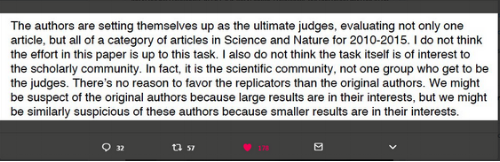

Returning to the topic of methods and evidence-based policy, two images popped up in my Twitter thread this week that I couldn't get out of my head. One is a snippet from a peer reviewer of the social science replication paper highlight above, explaining why it was not published in Nature or Science even though it was replications of papers from those journals. And second is a picture taken from a talk John List was giving this week about his career. You have to ask, does science advance via replication or via funerals? Via Brian Nosek and Ben Grodeck respectively.
Week of April 23, 2018
1. Communications: Marc Bellemare has a new post on how to communicate research titled "The Goal of Scientific Communication Is Not to Impress But to Be Understood." To which I say, the goal of human beings is not to be understood but to impress (hence the faiV). But assuming that you aren't as Calvinist as I am, I've been collecting a few things over the last few weeks that broadly fit the theme of better communicating research and ideas. Here's an experiment on disaster relief communications testing negative and positive imagery for their effect on donations and on donors sense of that change was possible. Unfortunately, there are few conclusions to draw; these are hard experiments to run. Here's a piece from ODI on 9 things you are doing, but shouldn't in research communications. I'm guilty of at least five (with mitigating circumstances, e.g. the funders told me I had to).
But let's get specific. Here's something you should definitely not do: produce a set of guidelines for behavior that have no input from the most important people in the equation. You should also not try to write jargony, provocative headlines without really understanding the context, for instance, saying that "40% of Older Americans Will Experience Downward Mobility." Given that the standard models of retirement planning assume that everyone retiring will have a lower income (hello there Lifecycle theory!), and most people aren't close to saving enough for retirement according to those standard models, I'm willing to bet a lot of money that the figure will be a lot higher than 40%. Don't try to find some way to contextualize a massive ritual sacrifice of children. And finally, definitely don't be one of these Manhattanites caught on video expressing revealed preferences for segregation and inequality, but do be like the principal at the end of the video clip and communicate your disgust in no uncertain terms.
2. Global Convergence: But not in a good way. I often think about the divergence in outcomes (or put another way, growing income and wealth inequality, falling mobility) for Americans as a convergence: for the bottom ~40% of the income distribution, the American economy looks a lot more like the economy in, say South Africa or Brazil, than the economy experience by the upper half of the distribution. That clip above is one example of how far out of reach the tools for mobility can be. Justin Fox has a story about fee-based governance in the United States--government agencies funding themselves through fines and fees. Justin makes the connection to the Gilded Age in the US, but it's a mechanism that will be very familiar to people in developing and middle-income countries. For a ray of hope on that front, you can check out Tishuara Jones, Treasurer of St. Louis, who is fighting back against fines and fees as revenue in her city.
3. Household Finance: This week I guest-taught a class at Haverford on US microfinance. In the post-discussion I learned that students prefer off-campus jobs, because Haverford pays student workers only once-a-month, and those who need the paycheck from a job during the semester, need it more frequently. That makes sense. But people on low-incomes also often prefer infrequent payments, so as to get larger lump-sums. Dairy farmers in Kenya do according to this new work from Casaburi and Macchiavello. To the convergence point earlier, this isn't a difference between the US and developing countries. The demand for income spikes among people in the US can be seen in the low take-up rates for monthly EITC payments, and the high take-up of "overwithholding." It's also evident in the fintech Even's pivot away from consumption smoothing. The bottom line is we still have a long way to go to understand optimal income volatility and we should have weak priors about the interest in and benefits of say, on-demand income or a "rainy day EITC."
Week of April 9, 2018
1. Global Development: Hey, does anybody remember the Millennium Villages Project? It seems an age ago in terms of development fads, now that we're all focused on cash grants and graduation programs, and according to some papers would fall into the "long-run" category. Andrew Gelman has a post about a new retrospective evaluation of the program (that he participated in), including a link to an evaluation of the evaluation. The results are surprisingly good, given what I expect most people's priors were at this point. Though I suppose the TUP evaluations should perhaps have shifted those priors in a positive direction. I guess I'm kind of surprised that the results don't seem to have gotten the attention I would have predicted. Of course, I don't think anyone has argued that the MVP should be a model for other programs since Nina Munk's book, so maybe I shouldn't be so surprised.
Lant Pritchett has a list of six other things in development that people aren't paying (enough) attention to, mostly variations on the continuing large gap between even the lower part of the income distribution in rich countries and the upper part of the distribution in poor countries.
Lant's first point is about the huge gains from moving. Here's a piece from a few weeks ago about the lack of geographic mobility, specifically rural to urban migration, in the United States where the overall tone is exasperation at these benighted people who stay in small towns (and ruin things for everyone else; it's an interview with Robert Wuthnow about his new book). It caught my eye because I can't imagine something like this being written about rural people in developing countries (without touching off a lot of blowback). But perhaps we should see more stuff like this about all forms of poor-to-rich geographic mobility. Speaking of those rural people, here's a new paper from Marc Bellemare about one of the dynamics that may be keeping the poorest people in rural areas (at least in Madagascar)--the intensification of income from agriculture.
2. Jobs: Last week I linked to the recent study of scheduling practices at The Gap that found that encouraging managers to set more stable schedules for retail employees led to higher productivity and sales for the firm. The exact mechanism for increased sales isn't completely clear, but it appears that managers shifted hours to more experienced workers, who unsurprisingly were more productive. While the study is encouraging overall--stable schedules are better for (most) workers and for employers--it also has a dark tinge. To see why, consider this Atlantic article about the future of jobs at Walmart (which, to its great credit, was well ahead of The Gap in experimenting with more stable schedules for its hourly workers, and other efforts to stabilize workers income). The macro trend is toward fewer jobs, at least in terms of how we used to define that term, for less-skilled and less-experienced employees, and declining job quality for those people. That's been happening at many companies (think of outsourcing of janitorial, security and similar jobs) for a long time. It seems an awful lot like what I understand has happened in European labor markets which are more regulated--stable jobs are limited, more workers, particularly the young pushed into contingent labor contracts with limited benefits, stability or security. From a distance this is fascinating: similar outcomes from radically different processes. But from a policy perspective it's frightening. In the economic development world, we've been talking for a long time about how to move more people into formal employment, like in developed economies. Meanwhile the developed economies are making great progress moving people into informal employment, like in developing countries. Maybe I should have called this item Global Undevelopment.
And to play to the academic part of my readership for a moment, here's a piece about how every effort to create better incentives in academic jobs makes things worse. I remain baffled at the general assumption in economics that managers know what they are doing, given the management they experience on a daily basis. While I can't vouch for the management abilities at the Open Philanthropy Project, chances are if you're a reader of the faiV you, or someone you know might be interested in these job openings.
3. MicroDigitalFinance: Is a neologism a step too far? Probably. But check out CFI's fellows program research agenda. There's a whole lot of "microdigital" there. Interestingly, to me at least, is that you could copy and paste these questions into a research agenda for the US financial services marketplace and no one would bat an eye, especially the ones about the changing nature of work.
Week of April 2, 2018
1. Global Development: To start us off, how about some rain on the "rising Kenyan middle class" parade? The core point--that gains from rising incomes that don't translate into durable assets can rapidly be erased, a perspective that should sound familiar to anyone with a passing knowledge of anti-poverty policy in the US.
But the real parade in global development in recent years has been on the value of delivering cash to poor households. This is a train that's been picking up steam for a long while. I would date the current push back to the first studies of Progresa/Opportunidades, the Mexican conditional cash transfer program. Momentum has steadily built around both the positive impact of cash transfers--that recipients don't waste the money, that they use the money productively--and dropping conditions. That momentum was built on many studies, but probably the two most well known in international circles are Blattman, Fiala and Martinez on cash transfers in Uganda, and Haushofer and Shapiro/GiveDirectly in Kenya. Both showed significant gains by recipients of unconditional cash.
Both of those papers were about relatively short-term effects. Both studies included longer-term follow-ups. And you know what's coming: the large positive effects seem to have disappeared in the medium term. Berk Ozler of the World Bank is currently playing the role of Deng (it's the closest I could get geographically) with two lengthy blog posts. The first, keying off comments from Chris Blattman in the recent Conversations with Tyler, but really delving into the recently released update to the Haushofer and Shapiro/GiveDirectly update is the important one for non-specialists. The second is very useful for understanding the specific details of interpretation. The posts also kicked off a number of useful Twitter conversations (here, here, here, here and here, though that's just a sample; just scroll through Chris's and Berk's timelines for more). Berk's first post also takes on the role that academics have played in stoking that momentum and is worth a close read.
I think it's also important to think through what is happening with cash transfers in light of not only of other studies of cash (like this one finding positive effects on the personality of Cherokee Native American kids whose families receive cash that was just officially published) but also other interventions. Deworming is one example--one big source of the controversy over the effects of deworming is that there isn't a medium-term biological effect to explain the the long-term economic effects. The Moving to Opportunity study is another--no short-term or medium-term gains, only long-term ones. And I have to note that the Native American paper is a frustrating example of Berk's critique of the role academics can play in raising expectations too high--the paper's title and abstract simply reference a large positive effect of cash transfers with no indication of when (now? 10 years ago? 30 years ago?), where or who the participants are, or even the size or mechanism of the transfers.
Week of March 12, 2018
1. Microfinance and Digital Finance: Apparently the "farmer suicide over indebtedness" hype train is kicking up again in India. That's not to imply that farmer suicides are not a serious issue. But Shamika Ravi delves into the data and points out that indebtedness doesn't seem to be the driver of suicides and so attacking lenders or forgiving debts isn't going to fix the problem. Certainly poverty and indebtedness add huge cognitive burdens to people that affect their perceptions and decisions in negative ways, including despair. Here's a new video about poverty's mental tax--there's nothing new here, but a useful and simple explanation of the concepts.
Last year (or the year before) I noted Google's decision to play a role in safeguarding people in desperate straits from negative financial decisions: the company banned ads from online payday lenders, in effect becoming a de facto financial regulator. This week, Google announced another regulatory action. Beginning in June it will ban ads for initial coin offerings (if you don't know what those are, congratulate yourself). While I'm all for the decision, it's strange for Google to conclude that these ads are so dangerous to the public that they should be banned, but not for three more months. Cryptocurrency fraudsters, get a move on! Meanwhile, the need for Google and Apple (and presumably Facebook, Amazon, Alibaba and every other tech platform) to step up their financial regulation game is becoming clearer. In an obviously self-promotional, but still concerning survey web security firm Avast found that 58% of users thought a real banking app was fraudulent, while 36% thought a fraudulent app was real. I don't really buy the numbers, but my takeaway is: people have no idea how to identify digital financial fraud. I wish that seemed more concerning to people in the digital finance world.
2. Our Algorithmic Overlords: I've had a couple of conversations with folks after my review of Automating Inequality, and had the chance to chat quickly with Virginia Eubanks after seeing her speak at the Aspen Summit on Inequality and Opportunity. My views have shifted a bit: in her talk Eubanks emphasized the importance of keeping the focus on who is making decisions, and that the danger that automation can make it much harder to see who (as opposed to how) has discretion and authority. A big part of my concern about the book was that it put too much emphasis on the technology and not the people behind it. Perhaps I was reading my own concerns into the text. I also had a Twitter chat with Lucy Bernholz who should be on your list of people to follow about it. She made a point that has stuck with me: automation, at least as it's being implemented, prioritizes efficiency over rights and care, and that's particularly wrong when it comes to public services.
I closed the review by saying that "the problem is the people"; elsewhere I've joked that "AI is people!" Well at least I thought I was joking. But then I saw this new paper about computational evolution--an application of AI that seeks to have the machine experiment with different solutions to a problem and evolve. And it turns out that while AI may not be people, it behaves just like people do. The paper is full of anecdotes of machines learning to win by gaming the system (and being lazy): for instance, by overloading opponents' memory and making them crash, or deleting the answer key to a test in order to get a perfect score. I think the latter was the plot of 17 teen movie comedies in the '80s. Reading the paper is rewarding but if you just want some anecdotes to impress your friends at the bar tonight, here's a twitter thread summary. It's funny, but honestly I found it far scarier than that video of the robot opening a door from last month. Apparently our hope against the robots is not the rules that we can write, because they will be really good at gaming them, but that the machines are just as lazy as we are.
To round out today's scare links, here's a news item about a cyberattack against a chemical plant apparently attempting to cause an explosion; and here's a useful essay on our privacy dystopia.
Week of March 4, 2018
1. Crappy Financial Products: The results are no surprise, but it remains troubling to see the numbers. “Color and Credit” is a 2018 revision of a 2017 paper by Taylor Begley and Amitatosh Purnanandam. The subtitle is “Race, Regulation, and the Quality of Financial Services.” Most studies of consumer financial problems look at quantity: the lack of access to financial products. But here the focus is on quality: You can get products, but they’re lousy. Too often, they’re mis-sold, fraudulent, and accompanied by bad customer service. These problems had been hard to see, but they’ve been uncovered via the Consumer Financial Protection Bureau Complaints database, a terrifically valuable, publicly accessible—and freely downloadable—database. (Side note: this makes me very nervous about the CFPB’s current commitment to maintaining the data.)
Thousands of complaints are received each week, and the authors look at 170,000 complaints from 2012-16, restricted to mortgage problems. The complaints come from 16,309 unique zipcodes – and the question is: which zipcodes have the most complaints and why? The first result is that low income and low educational attainment in a zipcode are strongly associated with low quality products. Okay, you already predicted that. On top of those effects, the share of the local population identified as being part of a minority group also predicts low quality. No surprise again, but you might not have predicted the magnitude: The minority-share impact is 2-3 times stronger then the income or education impact (even when controlling for income and education). The authors suspect that active discrimination is at work, citing court cases and mystery shopper exercises which show that black and Hispanic borrowers are pushed toward riskier loans despite having credit scores that should merit better options. So, why? Part of the problem could be that efforts to help the most disadvantaged areas are backfiring. Begley and Purnanandam give evidence that regulation to help disadvantaged communities actually reduces the quality of financial products. The culprit is the Community Reinvestment Act, and the authors argue that by focusing the regs on increasing the quantity of services delivered in certain zipcodes, the quality of those services has been compromised – and much more so in heavily-minority areas. Unintended consequences that ought to be taken seriously.
2. TrumpTown: Another great database. ProPublica is a national resource – a nonprofit newsroom. They’ve been doing a lot of data gathering and number-crunching lately. Four items today are from ProPublica. The first is the geekiest: a just-released, searchable database of 2,475 Trump administration appointees. The team spent a year making requests under the Freedom of Information Act, allowing you to now spend the afternoon getting to know the mid-tier officials who are busily deregulating the US economy. The biggest headline is that, of the 2,475 appointees, 187 had been lobbyists, 125 had worked at (conservative) think tanks, and 254 came out of the Trump campaign. Okay, that’s not too juicy. Still, the database is a resource that could have surprising value, even if it’s not yet clear how. Grad students: have a go at it. (Oh, and I’d like to think that ProPublica would have done something similar if Hilary Clinton was president.)
3. Household Finance (and Inequality): This ProPublica story is much more juicy, and much more troubling. Writing in the Washington Post, ProPublica’s Paul Kiel starts: “A ritual of spring in America is about to begin. Tens of thousands of people will soon get their tax refunds, and when they do, they will finally be able to afford the thing they’ve thought about for months, if not years: bankruptcy.” Kiel continues, “It happens every tax season. With many more people suddenly able to pay a lawyer, the number of bankruptcy filings jumps way up in March, stays high in April, then declines.” Bankruptcy is a last resort, but for many people it’s the only way to get on a better path. Even when straddled with untenable debt, it turns out to be costly to get a fresh start.
The problem will be familiar to anyone who has read financial diaries: the need for big, lumpy outlays can be a huge barrier to necessary action. Bankruptcy lawyers usually insist on being paid upfront (especially for so-called “chapter 7” bankruptcies). The problem is that if the lawyers agreed to be paid later, they fear that their fees would also be wiped away by the bankruptcy decision. So, the lawyers put themselves first. The trouble is that the money involved is sizeable: The lawyers’ costs plus court fees get close to $1500. The irony abounds. Many people tell Kiel that if they could easily come up with that kind of money, then they probably wouldn’t be in the position to go bankrupt. Bankruptcy judges see the problem and are trying to jerry-rig solutions, but nonprofits haven’t yet made this a priority. So, for over-indebted households, waiting to receive tax refunds turns out to be a key strategy.
Read MoreSEARCH BLOG
STAFF PICKS

Editor’s Note: I’m going to assume that you are seeing plenty of AI content (news and papers, not AI slop, though I’m sure you’re getting plenty of that too) from other sources, so I’m trying to think hard about the marginal value that the faiV can provide. As far as I’ve gotten so far: a) make sure that directly AI-related content does not take up more than 2 of the 5 items, and b) try to focus specifically on the cybersecurity issue for financial inclusion. Beyond that, I’m open to feedback on the value you get from the faiV in relation to AI to help guide us in the future. On a different note, I’ll be making a brief cameo appearance at the e-MFP Inclusive Finance Conference to moderate the opening plenary. If you haven’t registered, do so and I hope to see you there! - Tim Ogden