



What does it mean to live between poverty and the middle class? In a multi-media report released last week, Al Jazeera America digs into the lives of 5 Californian families that "earn too much to receive most government benefits yet too little to reliably make ends meet."

Olivia and Jose Aguilar in front of their niece's home in Modesto. Photo by E. Tammy Kim and Lam Thuy Vo
The piece profiles families with income below the self-sufficiency standard, a measure developed by the University of Washington in the 1990s. The self-sufficiency standard varies from household to household. It takes into account regional cost-of-living, ages of household members, and all major budget items. More people live below this standard than the federal poverty line, which doesn't allow for geographic cost differences and is based on assumptions about only the food portion of household budgets. According to Al Jazeera's report, the average self-sufficiency standard for a family of 4 in California is an annual income of $63,979 while the federal poverty threshold is only $23,850.
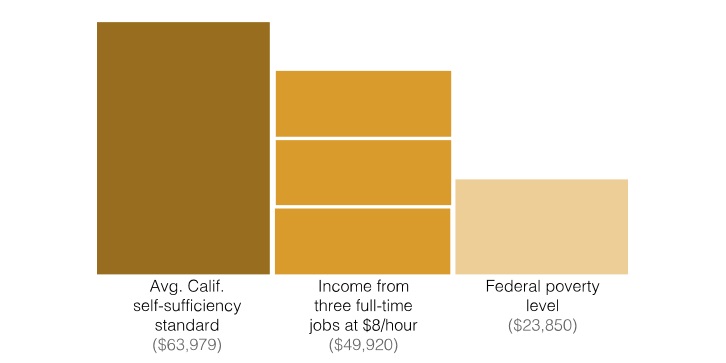
Many of the households followed by the U.S. Financial Diaries project also fall into this space between poverty and self-sufficiency. Like families profiled in by the Al Jazeera piece, they face financial challenges with housing, transportation, food, child care, and health care. The Financial Diaries methodology allows us to see even another layer of difficulty: income volatility. Contrary to what poverty and self-sufficiency standards imply, the story of a family's annual income gets more complicated when it's broken down month-by-month. Over the course of a year, one household's monthly income can bounce above and below the poverty line multiple times.
Financial Diaries’ panel data covers not only household income but also all kinds of cash flows and a range of other household stats that span the themes explored in Al Jazeera America’s report. The data informs how we think about both household-level financial challenges and the best way to measure poverty. As our analysis comes into focus, the Financial Diaries start to paint a fuller, more intimate picture of life on a tight budget.
This post was written by Julie Siwicki of the Financial Access Initiative. The views expressed therein are those of the author, and not necessarily of the USFD project or its funders.
Editor’s Note: I’m going to assume that you are seeing plenty of AI content (news and papers, not AI slop, though I’m sure you’re getting plenty of that too) from other sources, so I’m trying to think hard about the marginal value that the faiV can provide. As far as I’ve gotten so far: a) make sure that directly AI-related content does not take up more than 2 of the 5 items, and b) try to focus specifically on the cybersecurity issue for financial inclusion. Beyond that, I’m open to feedback on the value you get from the faiV in relation to AI to help guide us in the future. On a different note, I’ll be making a brief cameo appearance at the e-MFP Inclusive Finance Conference to moderate the opening plenary. If you haven’t registered, do so and I hope to see you there! - Tim Ogden